TL;DR: A successful B2B cold email campaign depends on strategy, not volume. You must target the right prospects, protect deliverability, personalize outreach, optimize campaigns, and follow up consistently to generate qualified leads.
If you are constantly struggling with wasted budget and unsatisfactory results, read the rest to explore our proven process and see how we generate qualified B2B leads through strategic cold email outreach.
Cold Email vs. Other B2B Lead Generation Channels
Cold email gives B2B businesses more control, scalability, and predictable outreach than most lead generation channels.
You can reach decision-makers with personalized messaging, measure every stage of the campaign, and scale prospecting without a significant increase in cost.
Unlike channels that depend on algorithms, advertising budgets, or limited availability, cold email creates a repeatable system for generating qualified conversations and sales opportunities.
Let’s compare cold email with other popular B2B lead generation channels:
| Lead Generation Channel | Cold Email | Cold Calling | LinkedIn Outreach | Networking Events |
| Scalability | High | Low | Medium | Low |
| Cost | Low | Medium | Low | High |
| Personalization | High | Medium | High | High |
| Reach | Thousands of prospects | Limited daily calls | Platform limitations | Limited attendees |
| Response Window | Prospects reply at their convenience | Requires immediate availability | Often delayed | Event dependent |
| Performance Tracking | Excellent | Limited | Good | Difficult |
| Automation | Extensive | Minimal | Partial | None |
If your goal is to generate qualified B2B leads at scale with measurable performance and lower acquisition costs, cold email remains one of the strongest outbound lead generation channels available today.
Why Strategy Matters More Than Sending More Emails
Many businesses believe that sending more cold emails will automatically generate more B2B leads. However, I noticed that consistent results come from following a structured strategy, not increasing sending volume.
Instead of focusing only on the number of emails sent, pay attention to these factors:
- Target the right ICP: Reaching businesses that match your solution increases relevance and reply potential.
- Compelling offer: A clear value proposition that addresses a real business challenge encourages meaningful conversations.
- Personalized outreach: Relevant messaging based on the prospect’s business creates stronger engagement and response rates.
- Email deliverability: Healthy domains, proper authentication, and sender reputation improve consistent inbox placement.
- Campaign optimization: Regular testing of subject lines, messaging, offers, and CTAs improves overall performance.
- Consistent follow-up: Multiple touchpoints keep conversations active and recover opportunities missed after the first email.
Want a proven cold email system for your business? Let my team handle the strategy and generate qualified B2B leads for you.
The Precise Cold Email Process We Follow at ProspectOut
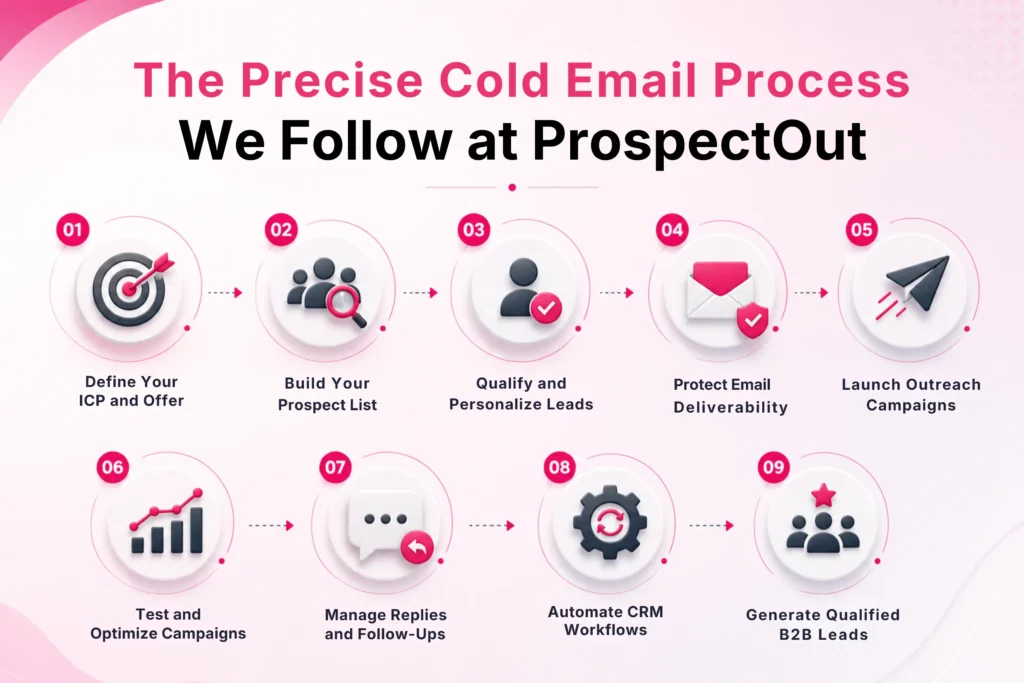
Here’s the process my team uses to build cold email campaigns that create consistent sales opportunities. Check each step thoroughly:
1. Define Your ICP and Offer
Every campaign starts with understanding who we want to reach and why they should respond. We analyze the industry, research competitors, and identify market gaps before creating an Ideal Customer Profile (ICP). This identifies the companies, decision-makers, and business challenges that match our client’s solution.
After defining the ICP, we create messaging angles that address real pain points instead of promoting generic services. Our focus is a compelling offer backed by a clear value proposition, making it easy for prospects to understand the business value. Starting with the right audience and the right offer increases positive reply rates from the first campaign.
2. Build Your Prospect List
Campaign performance depends on the quality of the prospect list. My team uses LinkedIn Sales Navigator, Apollo, and Google Maps to build targeted prospect lists instead of relying on generic databases.
Every prospect is filtered using criteria such as:
- Company fit
- Industry
- Job role
- Annual revenue
- Company size
- Technology stack
- Recent job openings
- Geographic location
Before launching a campaign, we verify every email address with MillionVerifier to reduce bounce rates, protect sender reputation, and improve inbox placement. Save hours of prospecting! Hire our team to build every list accurately for your business.
3. Qualify and Personalize Leads
Building a prospect list is only the first step. Before adding contacts to a campaign, we qualify every lead against the defined ICP. Our process combines AI-powered lead qualification with data enrichment to validate company information, decision-maker relevance, and purchase potential.
We also review each prospect’s website, products, services, and market position before writing outreach messages. This allows us to create dynamic personalization without sacrificing scale. The result is outreach that feels relevant, increases engagement, and generates more conversations with qualified prospects.
4. Protect Email Deliverability
A strong offer has little value if your emails never reach the inbox. That’s why email deliverability is a core part of our process before launching any campaign.
We build a healthy sending infrastructure by:
- Using secondary domains for cold outreach instead of the primary business domain.
- Configuring DNS records, including SPF, DKIM, and DMARC, to establish sender trust.
- Warming up every mailbox to build a positive sender reputation.
- Limiting sending volume to around 30 emails per account per day to protect domain health.
- Rotating sender accounts to distribute sending activity across multiple mailboxes.
- Monitoring domain health to reduce blacklist risks and maintain strong inbox placement.
This process protects sender reputation and creates a stable foundation for long-term cold email campaigns. Explore our approach to better inbox placement and improve your cold email performance.
5. Launch Outreach Campaigns
Once the infrastructure is ready, we launch outreach campaigns using platforms such as Instantly.ai, Reachinbox, and HeyReach. Each platform plays a role in managing outreach while keeping campaigns organized and scalable.
Our outreach process includes:
- Multi-step cold email sequences that keep prospects engaged.
- LinkedIn outreach to reinforce email communication.
- Personalized messaging for each ICP segment.
- Strategic follow-ups that increase reply opportunities.
- Engagement with target decision-makers across multiple touchpoints.
A coordinated outreach strategy creates more conversations than relying on a single communication channel. Ready to generate more qualified leads? Explore our B2B outreach campaign service and start more sales conversations.
6. Test and Optimize Campaigns
Cold email campaigns require ongoing testing to improve performance over time. Instead of relying on assumptions, we analyze campaign data and refine every stage of the outreach process.
Our optimization process includes testing:
- Different ICP segments.
- Subject lines.
- Offers and value propositions.
- Email copy.
- Calls to Action (CTAs).
- Sequence length and follow-up timing.
We measure reply rates, meeting rates, and conversion performance after every campaign. These insights guide future improvements, resulting in stronger engagement, more qualified conversations, and higher conversion rates.
7. Manage Replies and Follow-Ups
Receiving replies is only one part of a successful cold email campaign. The next step is managing every conversation with care and keeping prospects engaged throughout the buying journey. My team reviews incoming replies, identifies buyer intent, responds to positive inquiries, and addresses questions before they become obstacles.
Not every prospect responds to the first email, which is why follow-up plays such an important role. We build structured follow-up sequences and maintain multi-touch communication to reconnect with prospects who show interest but need more time.
This process nurtures relationships, increases response rates, and moves more prospects toward qualified sales opportunities.
8. Automate CRM Workflows
Managing hundreds of conversations across multiple campaigns requires an organized workflow. We connect our outreach platforms with the CRM to keep prospect data accurate and the sales pipeline up to date.
Our workflow automation includes:
- CRM integration for centralized lead management.
- Automatic lead tracking across every campaign.
- Real-time pipeline visibility for the sales team.
- Inbox forwarding to the right team members.
- Instant notifications for positive replies.
- Faster sales handoff once a prospect becomes sales-qualified.
9. Generate Qualified B2B Leads
The goal of our cold email process is not to generate replies alone. Our focus is converting engaged prospects into qualified B2B leads that match the defined Ideal Customer Profile and show strong buying intent. Every positive conversation goes through a qualification process to determine business fit, interest level, and potential sales value before moving to the next stage.
Once a prospect meets the qualification criteria, we schedule sales meetings and transfer every opportunity to the sales team with the context needed for productive conversations. Instead of delivering a list of contacts, we deliver sales-ready B2B leads that create stronger pipeline opportunities and increase the potential for new business.
What Results Can You Expect from a Structured Cold Email System?
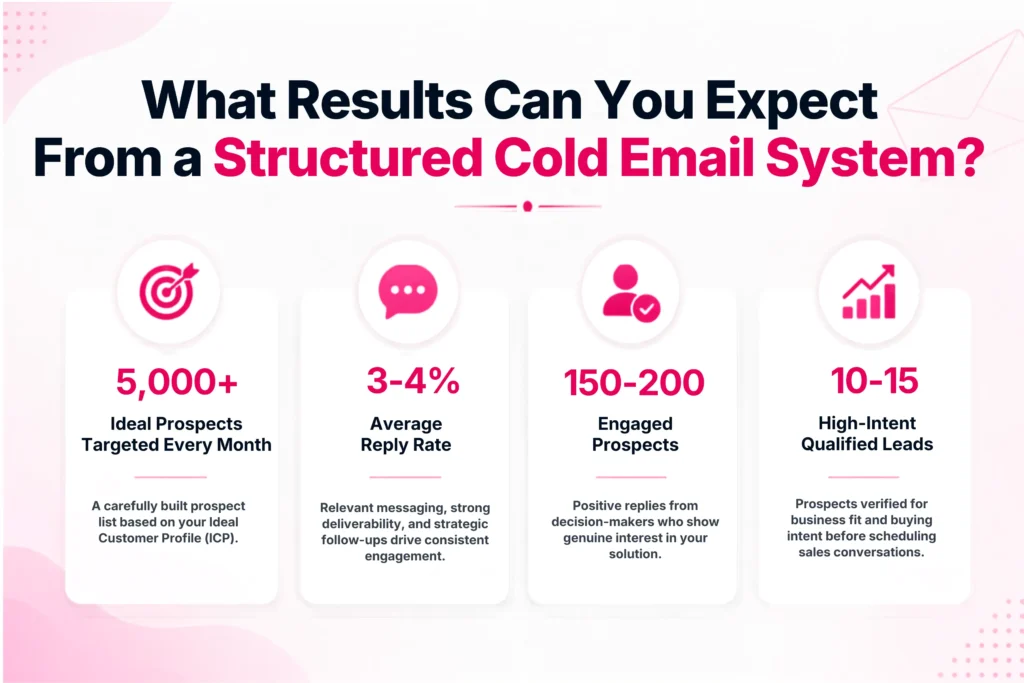
Every campaign produces different results based on your industry, offer, target market, and competition. However, a structured cold email system creates predictable performance because every stage from targeting to follow-up is built for continuous improvement.
Here’s a snapshot of the results we aim to achieve for a typical campaign:
- 5,000+ ideal prospects targeted every month: A carefully built prospect list based on your Ideal Customer Profile (ICP).
- 3–4% average reply rate: Relevant messaging, strong deliverability, and strategic follow-ups generate consistent engagement.
- 150–200 engaged prospects: Positive replies from decision-makers who show genuine interest in your solution.
- 10–15 high-intent qualified leads: Prospects verified for business fit and buying intent before scheduling sales conversations.
These numbers are not guaranteed, and campaign performance varies by industry, offer quality, market demand, and competition. Ready to generate more qualified B2B leads? Book a free call with our team, and let’s discuss a cold email strategy tailored to your business.
Final Opinion
Businesses often blame poor results on cold email, but the real issue is an unstructured process. Weak targeting, generic offers, poor deliverability, and inconsistent follow-up limit campaign performance long before the first email reaches a prospect’s inbox.
The businesses that achieve consistent growth treat cold email as a repeatable system instead of a one-time campaign. They refine every stage, from ICP selection and personalization to optimization and lead qualification.
Review our case studies to understand what a structured cold email system can achieve. Book an introductory call and discuss your lead generation goals with our team.
Frequently Asked Questions
Should I buy a B2B lead list or build one from scratch?
Buying generic lead lists often results in poor targeting and lower reply rates. A custom-built prospect list aligned with your Ideal Customer Profile delivers stronger campaign performance.
Can cold email work for niche B2B industries?
Yes. Cold email often performs well in niche industries because targeted prospecting and personalized messaging create stronger relevance and higher-quality conversations.
How do I know if my offer is the reason prospects aren’t replying?
If deliverability is healthy but reply rates remain low, review your offer, value proposition, messaging, and audience fit before increasing sending volume.