Thousands of cold emails are sent every day, but only a small percentage generate meaningful conversations. I’ve noticed that the biggest obstacle isn’t cold email itself, it’s the way most businesses approach it.
Many companies invest heavily in copywriting and automation but overlook the strategy that drives consistent results. Without the right audience, offer, infrastructure, and optimization, even the best-written email struggles to book qualified meetings.
In this article, I’ll share the complete cold email process my team follows to turn outreach into a predictable source of qualified B2B appointments.
Why Cold Email Stands Out for B2B Outreach and Appointment Setting
Businesses can generate B2B meetings through several outbound channels, but my observation is that not all of them deliver the same return on time and budget.
The most commonly used methods include:
- Cold email
- LinkedIn outreach
- Cold calling
- Industry events
Each channel has strengths, but cold email offers the best combination of scalability, cost efficiency, and measurable results.
| Channel | ROI & Limitations |
| Cold Email | Typically generates the lowest cost per meeting and can deliver 5x–10x ROI when backed by the right targeting, offer, and deliverability. It also scales efficiently without significantly increasing costs. |
| LinkedIn Outreach | Effective for building relationships, but daily connection and messaging limits reduce scalability. Many teams report 2x–4x ROI, depending on manual effort and personalization. |
| Cold Calling | Creates immediate conversations but requires dedicated sales reps, making it one of the most expensive outbound channels. Typical returns range from 1.5x–3x ROI, with a much higher cost per qualified meeting. |
| Industry Events | Can produce high-quality opportunities, but sponsorship, travel, and attendance costs are substantial. ROI often falls between 2x–5x, while meetings are limited to specific events and timelines. |
Cold email offers the best balance of cost, scalability, and measurable results. If you’re ready to generate more qualified B2B meetings, talk to our experts today.
Our End-to-End Cold Email Process for B2B Appointment Setting
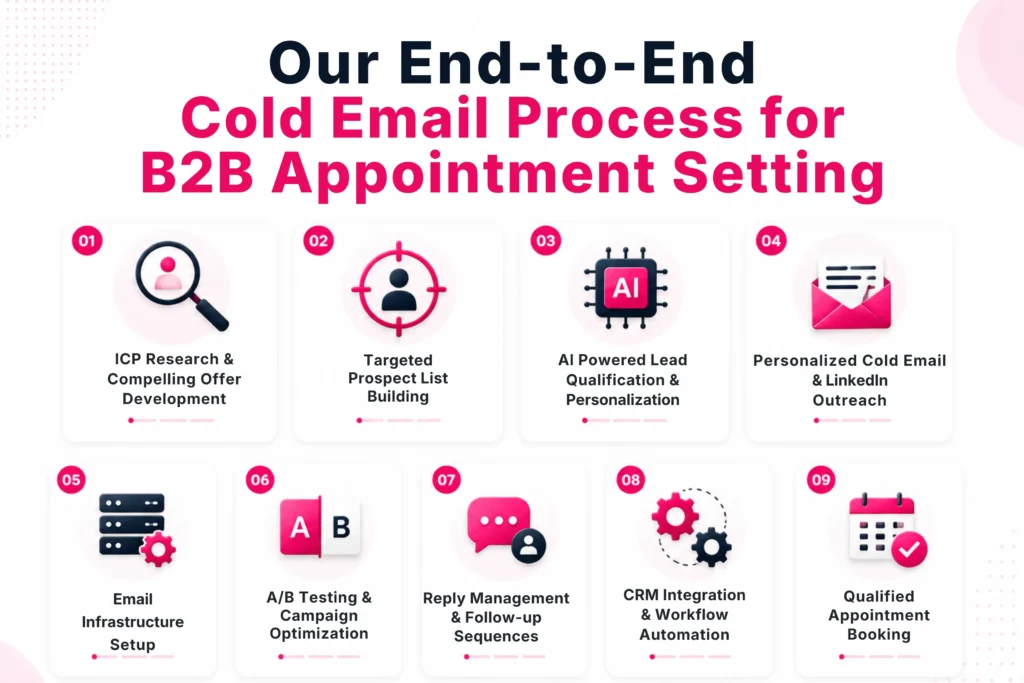
We have refined our cold email process through continuous testing, optimization, and real campaign data. This is the same process we follow to help businesses generate qualified B2B meetings.
Step 1: ICP Research & Compelling Offer Development
My team begins by identifying the ideal customer and developing an offer that speaks directly to their business challenges. We don’t treat these as separate tasks because both influence the success of the campaign from day one.
What Our ICP Research Looks Like:
Instead of relying on basic firmographic data, we research the factors that help us identify businesses most likely to benefit from our client’s solution.
| Research Area | Why We Analyze It |
| Industry | Understand the market, trends, and common challenges. |
| Competitors | Identify gaps and positioning opportunities. |
| Business Model | Understand how the company generates revenue. |
| Products or Services | Align the offer with what the prospect actually sells. |
| Growth Signals | Find businesses actively investing in growth. |
| Buying Triggers | Identify events that increase the likelihood of a response. |
Creating the offer after building the prospect list often results in generic messaging. Instead, we develop the offer alongside the ICP because both should shape each other from the beginning. I see that higher reply rates come from matching the right message with the right decision-maker.
For example, instead of saying “We provide lead generation services”, we position the offer around a specific outcome “We help B2B SaaS companies book qualified sales meetings through cold email outreach without relying on paid ads.”
Stop sending generic outreach. Build a winning ICP and offer for cold email that gets qualified prospects to respond.
Step 2: Targeted Prospect List Building
After defining the ICP and the offer, we start building a prospect list that matches both. I believe list quality has a much bigger impact on campaign performance than list size. A smaller list of highly relevant prospects outperforms a large list of random contacts.
Tools We Use:
- LinkedIn Sales Navigator – Find decision-makers using advanced filters.
- Apollo – Gather verified contact data and company information.
- Google Maps – Identify relevant local businesses for location-based campaigns.
How We Filter Prospects:
We don’t add every company that matches an industry. Instead, we filter prospects based on factors such as:
- Job role and decision-making authority
- Industry and niche
- Company size
- Annual revenue
- Technology stack
- Hiring activity and growth signals
Before any prospect is added to a campaign, we also verify every email address using MillionVerifier. This isn’t just about removing invalid emails. Verified email lists protect deliverability, reduce bounce rates, and improve the overall health of the campaign.
Tired of deliverability issues and high bounce rates? Get solid B2B list that rarely bounces and protect your sender reputation.
Step 3: AI-Powered Lead Qualification & Personalization
Though the prospect list is built, we don’t immediately start outreach. We first use AI and data enrichment to qualify every lead and confirm they’re a good fit for our client’s Ideal Customer Profile. This extra layer of validation helps us focus on prospects who are more likely to respond.
During this process, my team review information such as:
- Company website and services
- Business description and positioning
- Industry and target market
- Recent company updates or growth signals
- Other publicly available business information
Instead of treating personalization as a separate task, we make it a byproduct of qualification. The more we understand a business, the easier it becomes to write messages that feel relevant and natural without relying on generic merge tags like {{first_name}} or {{company}}.
This step is one of the biggest differences between strategic outreach and mass emailing. Rather than sending the same message to everyone, we make sure every prospect is a strong fit before the first email is ever sent.
Step 4: Personalized Cold Email & LinkedIn Outreach
Once the prospect list is qualified, my team builds a multi-channel outreach campaign instead of relying on email alone. We combine cold email with LinkedIn outreach to create multiple touchpoints and increase the chances of starting a conversation.
Every campaign is built around a highly personalized cold email strategy that reflects the prospect’s business, not just their name or company.
Tools We Use:
- Instantly.ai – for cold email outreach and campaign management.
- Reachinbox – for cold email automation and inbox management.
- HeyReach – for LinkedIn outreach automation.
Rather than sending a single email, we create a strategically written multi-step sequence. Each message has a purpose, whether it’s introducing the offer, providing additional value, following up, or encouraging a response.
I often notice that prospects rarely reply after seeing just one touchpoint. Reaching out through both email and LinkedIn builds familiarity and gives prospects more opportunities to engage.
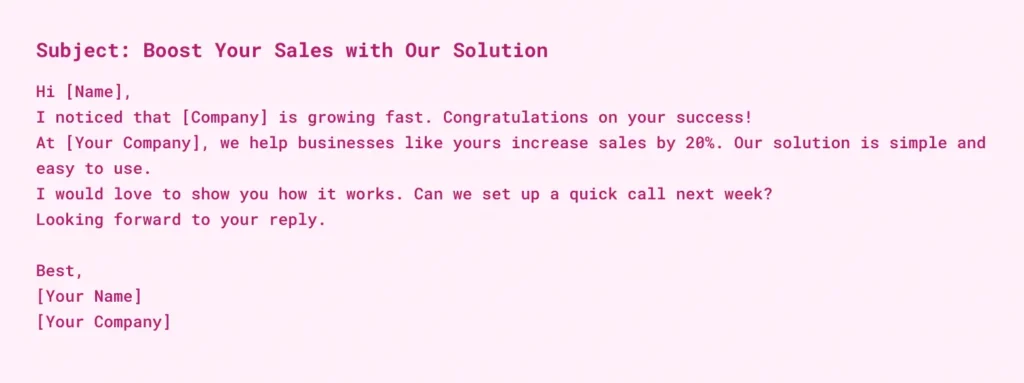
Here is an example of a good cold email for B2B appointment setting:
Step 5: Email Infrastructure Setup
This is the step many businesses overlook, but it’s one of the most important. You can have the best prospect list and a highly personalized cold email, but neither will generate results if your emails never reach the inbox.
What We Set Up
- Domain purchasing for outreach
- SPF, DKIM, and DMARC authentication
- Professional mailbox setup
- Inbox warm-up before sending campaigns
- Sender account batching for volume outreach
My team treats email infrastructure as the foundation of every campaign. Before launching any outreach, we make sure every sending domain and mailbox is properly configured and warmed up. This helps build sender reputation and reduces the risk of emails landing in spam.
As sending volume increases, we distribute campaigns across multiple sender accounts using our two-batch rotation strategy instead of relying on a single mailbox. While one batch actively sends outreach, the other remains on warm-up. We then rotate them regularly to protect deliverability and maintain healthier sender domains.
Maximize inbox placement with our cold email infrastructure service for high deliverability.
Step 6: A/B Testing & Campaign Optimization
Launching a campaign is only the beginning. My team continuously monitors performance and makes improvements based on real campaign data. We don’t treat cold email as a “set and forget” strategy because small changes can significantly improve results over time.
What We Test
- Ideal Customer Profiles (ICPs)
- Subject lines
- Offers
- Email copy
- Calls to action (CTAs)
- Outreach channels
Instead of making assumptions, we let the data guide our decisions. Ongoing testing helps us identify what resonates with the target audience and continuously improve reply rates, meeting bookings, and overall campaign performance.
Step 7: Reply Management & Follow-Up Sequences
Generating replies is only part of the process. My team also focuses on responding quickly, managing conversations, and following up with prospects who don’t reply immediately. I’ve found that many opportunities are created through consistent follow-ups rather than the first email alone.
We use a multi-touch follow-up approach to keep the conversation moving without overwhelming prospects. Every follow-up is written with a purpose, whether it’s providing additional value, answering potential objections, or simply checking in at the right time.
When a prospect shows genuine interest, we nurture the conversation and guide it toward a meeting with the right decision-maker. Our goal isn’t just to generate replies, it’s to turn qualified conversations into booked appointments.
Step 8: CRM Integration & Workflow Automation
Once prospects start replying, we keep every conversation organized through CRM integration and workflow automation. This ensures no interested lead is missed and gives our clients complete visibility into their outreach pipeline.
Interested replies are forwarded to the client’s sales team in real time, allowing them to respond quickly while the prospect is still engaged. In my experience, faster response times often lead to more booked meetings and a better experience for both the client and the prospect.
Step 9: Qualified Appointment Booking
The final goal isn’t to fill a calendar with meetings. It’s to book conversations with decision-makers who match the Ideal Customer Profile and have genuine business potential.
Before scheduling an appointment, my team confirms that the prospect is a good fit based on the agreed qualification criteria. This lets our clients spend their time speaking with businesses that are more likely to become customers instead of attending meetings that go nowhere.
The quality of appointments always matters more than the quantity. A smaller number of well-qualified meetings consistently creates better sales opportunities than a calendar full of conversations with the wrong prospects.
Ready to book qualified sales meetings? Use our proven cold email strategy.
My Final Perspective
Looking back on more than seven years in B2B cold email outreach, my observation is that most businesses don’t struggle because cold email is ineffective. They struggle because they overlook the process behind it.
My team and I have spent a long time refining every stage of our outreach at ProspectOut, from targeting and messaging to deliverability and follow-up. The technology and tools will continue to evolve, but the fundamentals remain the same. Build a strong foundation, keep optimizing, and stay consistent. That’s what turns cold outreach into a reliable source of qualified appointments.
Frequently Asked Questions
What is the ideal campaign size for a B2B cold email campaign?
Start with a small, highly targeted list and scale gradually. I saw that quality prospects consistently outperform large lists with poor targeting.
How long does it take to book appointments through B2B cold email?
Most campaigns begin generating replies within a few weeks. The timeline depends on your offer, targeting, deliverability, follow-up strategy, and campaign optimization.
Should I outsource B2B cold email appointment setting?
If your team lacks outreach expertise or resources, outsourcing can accelerate results. An experienced partner manages strategy, execution, optimization, and qualified appointment booking.