

Cold email outreach in B2B markets often fails because messages sound repetitive and automated. When prospects receive similar emails over and over, engagement drops and deliverability suffers.
Spintax offers a practical way to solve this problem by creating controlled variations within a single email template. It helps scale outreach while keeping messages fresh, natural, and less predictable for email filters.
Using Spintax correctly improves both inbox placement and response rates when combined with strong targeting and clear messaging.
In this article, we will break down how Spintax works, where to use it, and how to apply it effectively in B2B campaigns.
What Is Spintax in Cold Emails?
Spintax is a format that lets you write multiple versions of a sentence in one line using brackets and separators. Email tools then rotate the options to create different outputs.
For example: {Hi|Hello|Hey} John, {I saw|I noticed} your recent post. Each send can look slightly different.
How it creates multiple email variations:
- Uses brackets {} to group word or phrase options.
- Separates choices with the pipe symbol |.
- Randomly selects one option from each group.
- Combines selected parts into a full sentence.
- Produces many unique email versions from one template.
Spintax helps B2B cold email outreach stay fresh and avoid repetition. It reduces the risk of spam filters flagging similar messages and improves reply rates. Teams use it to scale campaigns while keeping emails varied and more natural for each recipient.
Also read: Is it illegal to send emails without permission?
How to Use Spintax in B2B Cold Emails
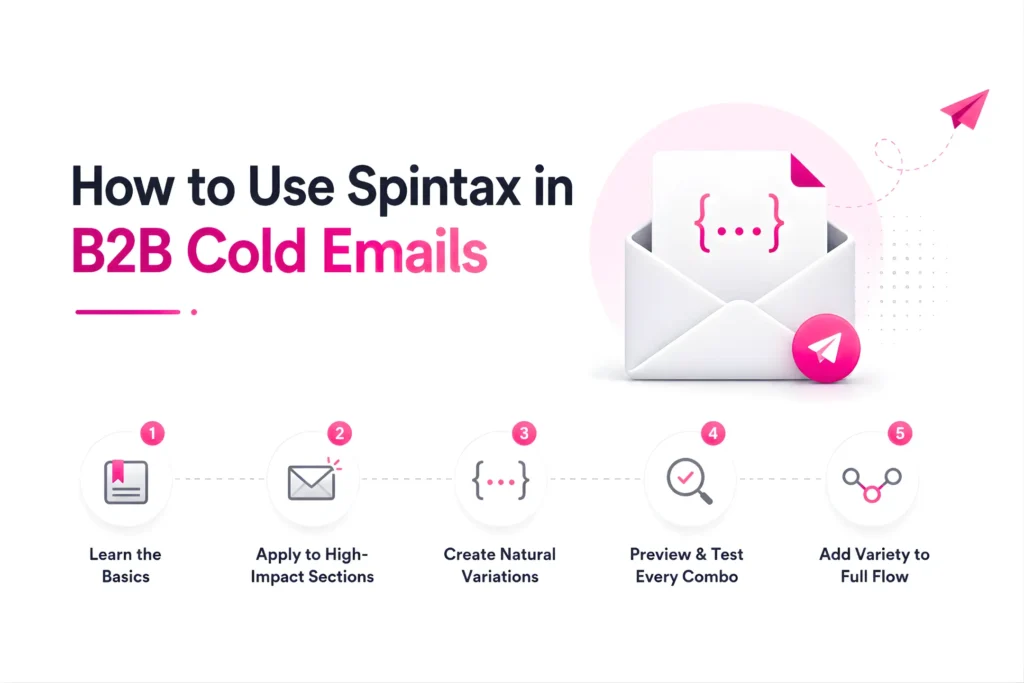
You can follow the steps below to use Spintax during cold email outreach:
1. Learn the Basic Spintax Structure
Spintax relies on curly brackets {} to group variations and the pipe symbol | to separate each option, and every send pulls one choice from each group to form a complete sentence. When used correctly, this structure creates clean variation without harming clarity.
Simple structures perform better and reduce the chance of errors, especially at scale. Teams that try to overcomplicate Spintax early often face readability issues, so a controlled and structured approach works best for long-term campaigns.
Example: {Hi|Hello|Hey} {{FirstName}}, I {noticed|saw|came across} your recent update.
2. Apply Spintax to High-Impact Sections
We have seen the strongest results when Spintax is applied to sections that directly affect engagement, such as subject lines, greetings, and calls to action. These parts shape the first impression and often decide if the recipient opens or responds to the email.
Subject lines should remain direct and relevant, while CTAs should feel natural and easy to respond to. Instead of overloading one sentence with variation, we spread it across multiple sections to create balanced diversity. This method keeps emails fresh without reducing readability or focus.
Examples:
Subject: {Quick question|Idea for|Regarding} {{Company}}’s strategy
Greeting: {Hi|Hello|Hey|Hi there} {{FirstName}},
CTA: {Can we talk?|Open to a quick chat?|Interested in learning more?}
3. Create Natural Variations
Based on our campaign data, writing three to five variations per Spintax block delivers the best balance between diversity and control. This range allows enough variation to avoid repetition while keeping the message consistent across all versions.
Focus on maintaining the same meaning in every variation, since shifting the message can confuse the reader and reduce trust. Each option should fit smoothly into the sentence, both in tone and structure. Clear and simple wording tends to perform better in cold outreach, as it keeps the message easy to read and quick to understand.
Review each variation separately before combining them, since this helps identify weak or unnatural phrasing early. Strong variations make the email feel more personal, even when it is sent to a large audience.
Example: We help companies {increase revenue by 20%|cut operational costs by 15%|scale faster}.
4. Preview and Test Every Combination
Even well-written Spintax can produce awkward combinations if not reviewed carefully. Most outreach tools provide a preview function, which we always use to generate multiple variations and check how they read in real scenarios.
Look for consistency in grammar, tone, and flow across different combinations, since small issues can impact credibility. Running several previews helps catch mismatched phrases that might otherwise go unnoticed. After sending campaigns, track performance data to see which variations generate better engagement.
Example: {Hi|Hey} {{FirstName}}, I {noticed|saw} your team is growing fast.
5. Add Variety to Full Email Flow
Applying Spintax across the full email creates a more natural and less repetitive experience for the reader. Instead of limiting variation to a single line, extend it to the opening, value statement, and closing, which allows the entire message to evolve with each send.
Keep all variations aligned with the same goal, so the message stays focused and easy to follow. Adding unrelated options can weaken the flow, so we always prioritize clarity over quantity. A well-structured email with balanced variation feels more like a real conversation and less like an automated message.
This approach helps scale outreach efforts while maintaining a professional tone and consistent quality across every email sent.
Example: {Hi|Hello} {{FirstName}}, I {noticed|saw} your company is expanding. We help teams {grow faster|reduce costs|boost results}. {Best|Regards|Cheers},
Why Is Spintax Important for B2B Cold Email Deliverability?
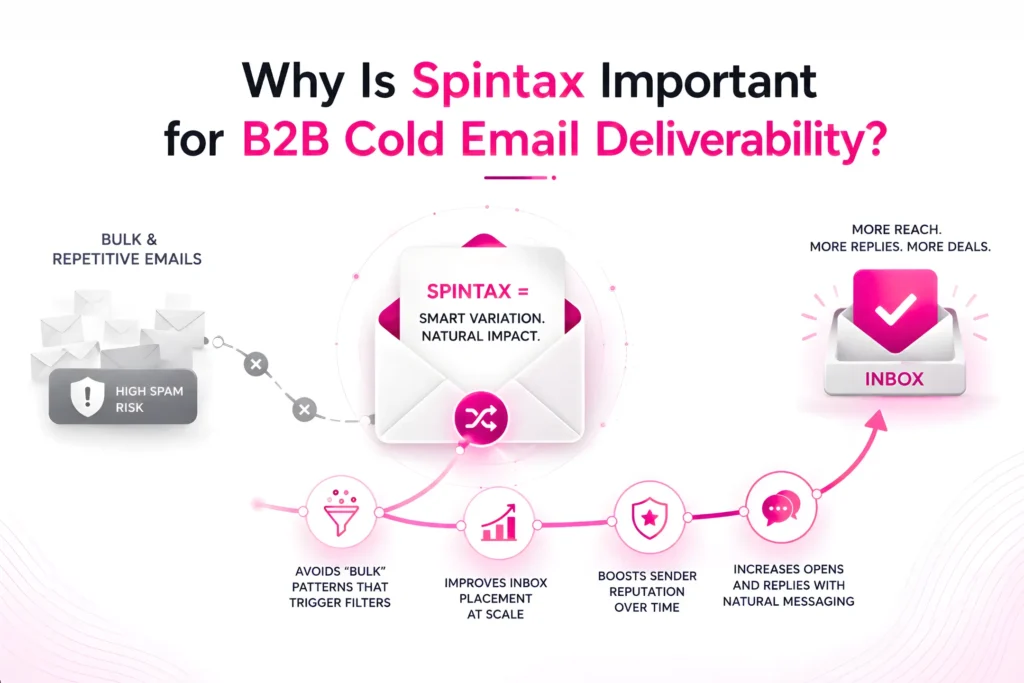
Spintax is important for B2B cold email deliverability because it creates unique, slightly varied messages from a single template, so spam filters treat them as less “bulk” and more personalized. This reduces the risk of your whole campaign being flagged as spam and improves inbox placement rates at scale
Email providers scan patterns across large batches of messages, and identical wording often signals automated or low-quality outreach. In our experience, campaigns without variation face higher spam placement and lower inbox rates.
Spintax breaks these patterns by introducing controlled differences in phrasing, which makes each email look unique. This reduces filtering risks and supports better inbox placement. It also improves sender reputation over time, since engagement signals like opens and replies tend to increase with more natural messaging.
Spintax vs Personalization: What’s the Difference?
Spintax creates structural variation inside a template (e.g., “{{Hi|Hello}} {First Name}”), while personalization inserts recipient‑specific data (e.g., name, role, company news) to make each email feel hand‑written.
Spintax mainly helps deliverability; personalization boosts relevance and reply rates.
| Aspect | Spintax | Personalization |
| Purpose | Adds variation to avoid repetition. | Makes emails relevant to each recipient. |
| How it works | Rotates predefined word or phrase options. | Inserts unique data for each contact. |
| Focus | Message diversity at scale. | Individual relevance and context. |
| Example | {Hi|Hello} {{FirstName}} | Hi John, saw your role at XYZ |
| Impact on deliverability | Reduces spam risk through variation. | Improves engagement and response rates. |
| Data needed | No external data required. | Requires accurate contact data. |
| Best use case | Large campaigns needing variation. | Targeted outreach with deeper research. |
Where Should You Use Spintax in a Cold Email?
Use Spintax in sections that influence opens and replies. Focus on visible and action-driven parts of the email to keep messages varied, natural, and less repetitive.
The key parts include:
- Subject lines
- Opening lines
- Greetings
- Value propositions
- Call-to-actions (CTAs)
- Follow-up emails
- Closing lines
How Much Spintax Should You Use in One Email?

We recommend using 8–12 strategic Spintax variations per email to balance diversity and clarity. This range keeps messages natural, avoids awkward phrasing, and supports better deliverability and engagement.
| Email Section | Recommended Variations | Example / Suggestion |
| Subject Lines | 2–3 variations | {Quick question|Idea for|Question about} |
| Greetings | 2–3 variations | {Hi|Hello|Hey} |
| Opening Lines | 2–3 variations | Short intro variations that keep personalization clear |
| Body Copy | 4–6 variations | Adjust phrasing while keeping the same offer |
| CTA / Closing | 1–2 variations | {Worth exploring?|Do you have time?} |
Common Mistakes When Using Spintax
Many use Spintax in B2B cold emails in the wrong way. This often reduces clarity, hurts deliverability, and lowers reply rates across campaigns. Some are mentioned here:
- Adding too many options in one sentence makes emails hard to read. Example: {Hi|Hello|Hey|Greetings} {{FirstName}}, {hope you are well|wish you good day|trust all is fine}
- Mixing different grammar styles inside one Spintax block breaks sentence flow. Example: We {helps|helping|helped} companies {grow|growth|growing} faster
- Changing the main meaning inside variations confuses the reader. Example: We help companies {increase sales|lose revenue|reduce profits}
- Not checking previews before sending leads to broken or awkward emails. Example: {Hi|Hello} {{FirstName}}, I {noticed|saw} your {team growing|}
- Using Spintax in every line reduces clarity. Example: {Hi|Hello} {{FirstName}}, we {help|support} {companies|businesses} {grow|scale} fast {Best|Regards}
How Spintax Helps Scale Cold Email Outreach for B2B Companies
Spintax lets us create unique email variations at scale, which improves deliverability and helps avoid spam filters while sending large B2B cold email campaigns.
In our experience, scaling cold outreach without Spintax quickly leads to repetition across messages. Email providers detect repeated patterns and often push those emails to spam or low-priority folders.
Spintax solves this by generating multiple versions of the same message using controlled variations in wording, structure, and tone. This makes each email look unique, even when the core message stays the same. As a result, inbox placement improves, and campaigns maintain consistent performance across large lists.
Small variations in greetings, subject lines, and CTAs help each message feel more personal. This improves trust with recipients and increases reply rates over time.
Final Thoughts
Spintax works best as a structure tool, not a shortcut for weak messaging. It helps scale cold email outreach without losing variety, but it still depends on strong writing and clear intent. When you treat Spintax as a way to fix poor copy, results usually stay low. When you use it to support good copy, performance improves steadily across campaigns.
We also see that success comes from balance. Too little variation creates repetition, while too much creates confusion. The best results come from controlled use, careful testing, and consistent tone. Spintax should support human-like communication, not replace it.
Frequently Asked Questions
Can Spintax work with email outreach tools automatically?
Yes, most modern cold email tools support Spintax natively. Once you add the format, the system generates variations automatically during sending without extra setup.
Does Spintax affect email personalization fields like name or company?
No, Spintax works alongside personalization tags like {{FirstName}} or {{Company}}. It only changes predefined text options, not dynamic data fields.
Can Spintax reduce email spam complaints?
It can help indirectly by making emails less repetitive and more natural. However, spam complaints mainly depend on targeting, list quality, and message relevance.
Should Spintax be used in follow-up sequences too?
Yes, follow-ups benefit from Spintax as well. It keeps repeated touches from sounding identical and helps maintain engagement across multiple sends.
Is Spintax useful for small email campaigns?
Even small campaigns can benefit from Spintax. It adds variation and helps test different messaging angles without rewriting every email manually.