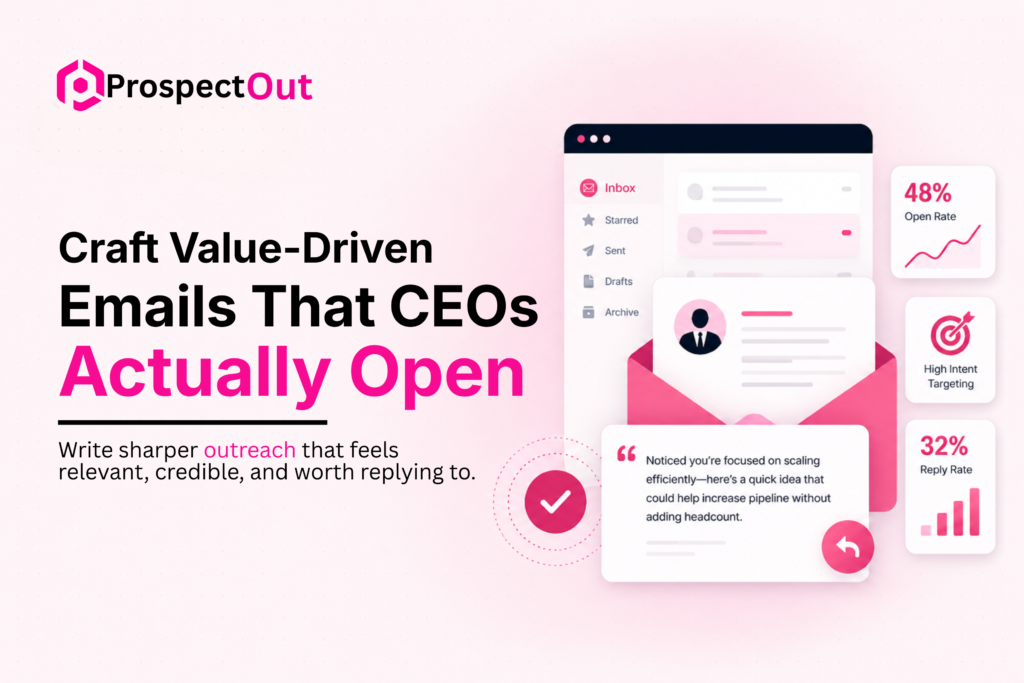
At a Glance: CEOs make fast decisions about which emails deserve attention. A short, relevant subject line, a clear business-focused offer, and a simple call to action increase the chances of your email being opened and earning a reply.
In this blog, we discuss how to craft a value-driven cold email to a CEO that captures attention, communicates value, and encourages meaningful responses.
Why Most Cold Emails to CEOs Fail
Many businesses struggle with cold outreach because they repeat the same methods that fill executive inboxes every day. Here are the reasons why many cold emails fail:
- Generic subject lines
- Long introductions and unnecessary details
- Repeated offers that look identical to competitors
- Lack of clear value
- Sending at the wrong time
CEO Thought Process Before Opening Cold Emails
Strong outreach starts with knowing how CEOs process information:
CEOs have limited time and attention
CEOs switch between meetings, calls, reports, and internal decisions all day. Long emails create extra effort and slow down decision making. Most executives prefer short messages that reach the point fast. When emails add unnecessary detail, they get ignored because time is the main constraint in daily leadership work.
They quickly scan emails for value
Executives rarely read every word in a cold email. They scan the subject line, opening line, and a few phrases to judge relevance. If the value is not clear in seconds, the email loses attention. Clear structure and direct language help the reader decide fast without spending mental energy on interpretation.
They ask questions like:
- Is this relevant to me?
- Does this solve a problem?
- Why should I care?
- Is this different from what I already receive?
These questions guide quick judgment inside a crowded inbox. If the email does not answer them early, it gets skipped.
Create Subject Lines That Trigger Curiosity
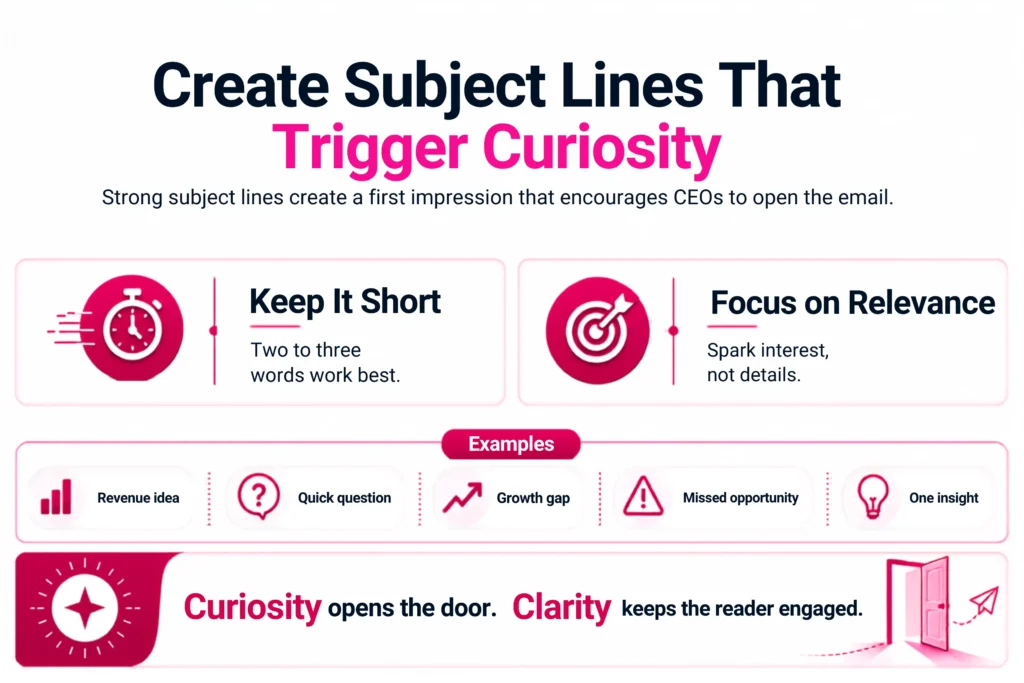
Strong subject lines create a first impression that encourages CEOs to open the email. So:
Keep It Short: Two to Three Words Works Best
Short subject lines get more attention because they look clean and easy to read. CEOs often check emails on mobile, where long lines feel crowded and hard to process. A short phrase creates quick interest and pushes the reader to open without overloading them with too much information at first glance.
Focus on Relevance, Not Details
Many senders try to explain the full offer in the subject line. This reduces curiosity and lowers open rates. The goal is to spark interest, not explain everything. Simple phrases like the ones below work better because they stay connected to business goals while still leaving space for curiosity and intent.
- Examples:
- Revenue idea
- Quick question
- Growth gap
- Missed opportunity
- One insight.
Mistakes to Avoid in Subject Lines
Several errors in cold email subject lines reduce performance and cause CEOs to ignore before even reading the main message:
➮ Long sales-focused headlines: People lose attention when subject lines become too long.
➮ Too many promises: Claims such as “Double Revenue in 30 Days” create doubt.
➮ Clickbait language: Executives can spot exaggerated tactics quickly.
➮ Excessive capitalization: Writing “READ THIS NOW” or “BIG BUSINESS OPPORTUNITY” often looks like spam. Simple language usually performs better.
Your Offer Is the Real Reason CEOs Open Emails
Subject lines matter, but the offer inside the email matters more. Here we discuss how to shape offers that create real interest in crowded executive inboxes:
Ask One Critical Question Before Sending
Ask yourself a simple question before writing the email: “Am I sending the same offer everyone else sends?”
Many teams skip this step and repeat familiar pitches. In our outreach work, we see that CEOs respond less when messages feel repeated. Inbox fatigue builds fast when similar claims appear daily without a new angle or clear difference in value.
Why CEOs ignore repetitive pitches
People stop reacting when messages feel repeated and predictable. CEOs face similar offers every day, so attention drops quickly. If nothing feels different, the email gets ignored.
The issue is not the service itself, but the lack of distinction in how it is presented. Repetition removes curiosity and lowers the chance of engagement.
Common offers that become invisible:
- We help increase leads
- We improve SEO
- We build websites
- We manage ads
- We provide marketing services
Nothing separates these messages from hundreds of others.
How to Make Your Offer Different
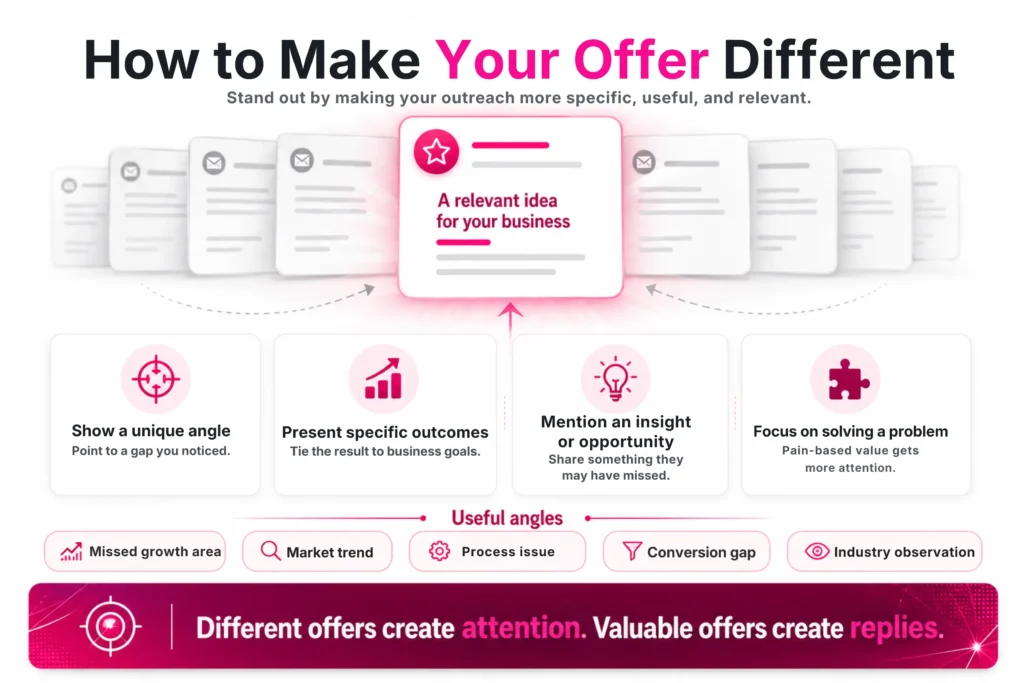
Strong B2B lead generation requires a clear angle that separates your offer from common outreach messages. Think about these to make your offer distinct:
➮ Show a unique angle: Instead of saying you increase leads, mention a gap you noticed.
➮ Present specific outcomes: Focus on a result tied to business goals.
➮ Mention an insight or opportunity: People react when they see information they may have missed.
➮ Focus on solving a problem: Problems create urgency. Solutions connected to actual business pain often receive more interest than broad service descriptions.
Shift from Selling to Providing Value
Many cold emails try to close a sale in the first interaction that can create resistance. Value-first outreach creates a different experience.
A message might mention:
- A missed growth area
- A market trend
- A process issue
- A conversion gap
- An industry observation
Benefits matter more than features. Instead of saying, “We provide appointment setting services,” explain the result.
For example:
“We noticed companies in your space lose qualified opportunities because response times increase after initial lead contact.”
That statement creates relevance and opens discussion.
Find Strong Reasons a CEO Should Open Your Email
Strong outreach needs a reason for existing. Below we explain how to build clear differentiation that gives CEOs a real cause to open your message:
Compare Yourself to Competitors
Think of a situation where you and another company email the same CEO on the same day. Both messages promote lead generation services, both highlight strong outcomes, and both ask for a meeting. The CEO sees no clear difference.
That raises a simple question: why should your message get attention over the other one? This thinking pushes you to build stronger positioning, clearer value, and a reason for preference.
Questions to Ask Yourself
Several questions can improve message quality and remove weak points before sending. Each question helps refine what you are offering and how it is framed.
If you cannot answer these clearly, the email will feel generic and lose impact:
- What unique insight am I bringing?
- What problem am I helping solve?
- Can I provide evidence or results?
- Why is my message worth their time?
Personalization Beyond Using Their Name
Personalization is often reduced to using a first name, which has little effect on response. Real personalization requires context about the company and its situation. Research matters before writing.
Look at what is happening inside the business and connect your message to that reality:
- Product launches
- Hiring activity
- Expansion plans
- Industry changes
- Business goals
Tie your message to a real challenge linked to these points. Strong personalization builds relevance and improves engagement.
A line like:
“I noticed your company expanded into a new market last quarter and saw an area that may affect lead conversion.”
feels stronger than:
“Hi John, I hope you are doing well.”
Best Time to Send Cold Emails to CEOs
Timing affects visibility more than many businesses expect. Let’s explain when CEOs are most likely to check emails and how timing can influence open rates and response behavior:
Why Timing Affects Open Rates
Decision makers receive emails across the full day, which creates constant inbox competition. As meetings, reports, and discussions build up, attention shifts away from new messages.
Sending at the right moment increases the chance of visibility before the inbox gets crowded. Timing helps your email appear when focus is still fresh and decisions are easier to make.
Recommended Time Window
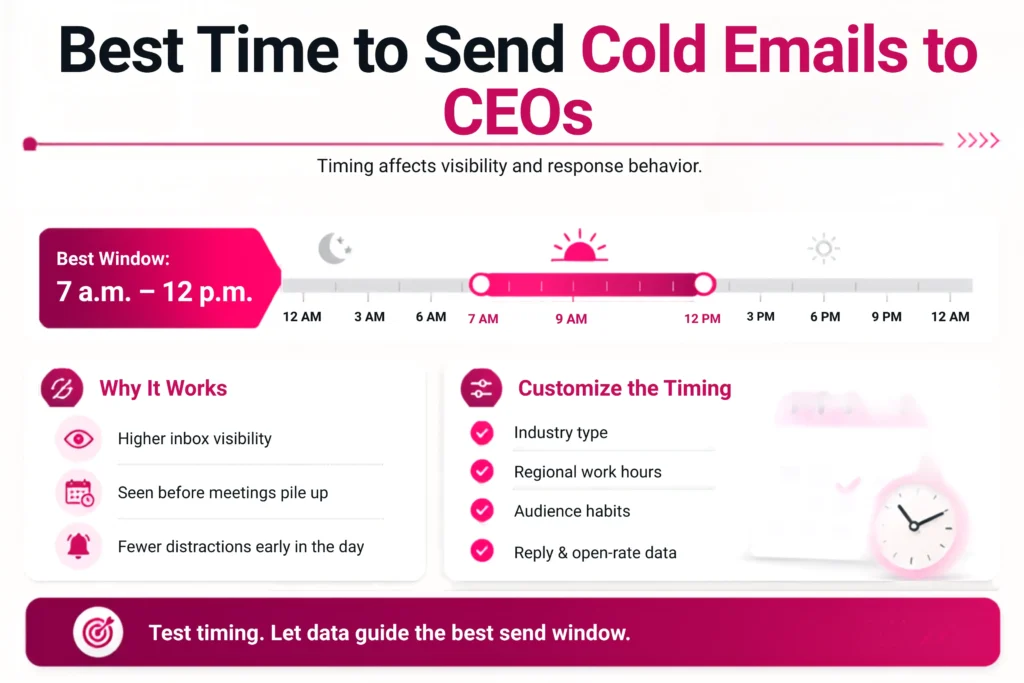
We often see stronger engagement between 7 a.m. and 12 p.m. during working days. CEOs often check emails early while planning priorities for the day.
A message delivered in this window is more likely to be seen before meetings start. Early visibility increases the chance of opening because fewer distractions compete for attention.
Customizing the Timing
No single timing rule fits every industry or region. Work habits differ across sectors, and executive schedules vary widely. Some industries respond better in the afternoon or late morning. Monitoring open rates and replies shows what timing drives better engagement and meetings.
Important factors to test before finalizing timing:
- Industry type changes response behavior
- Regional work hours affect inbox activity
- Audience habits shape best sending time
- Testing reveals stronger performance windows
- Data from replies guides timing choices
Simple Structure of a High-Converting CEO Cold Email
Good cold email writing stays focused and easy to scan. Below we break down each part of a simple structure that helps CEOs read faster and respond with interest:
Subject Line and Copy
A strong subject line should stay short and easy to process in seconds. Relevance matters more than explanation because CEOs make quick decisions based on first impressions. Keep the wording simple so it feels direct and clear.
Some examples include:
- “Revenue idea”
- “One insight”
- “Growth gap”
Also remember that CEOs are busy. So the email itself should be just 2–3 concise lines with one clear offer. Avoid long introductions or unnecessary explanations. Get to the point quickly, explain the value, and make the next step easy to understand.
Personalized Opening
Start the email with a line that connects directly to the company or its recent activity. This shows the message is not random and has some context behind it.
Avoid generic greetings that feel copied. The tone should stay natural and simple so it feels like a real observation instead of a sales script.
Mention a recent development or business activity and keep it natural.
Value Proposition
This part should explain the business issue clearly and show what result can follow. Focus on what changes for the company instead of listing services.
Keep sentences direct so the reader understands the impact quickly. CEOs respond more when they see a clear business outcome rather than a long service description or technical detail.
Stay specific and focus on impact rather than service descriptions.
Clear Call to Action
Avoid heavy or complex requests that create friction. The goal is to make the next step easy and low pressure. Simple questions often work better because they feel easier to answer.
Keep the request focused so the reader does not need to think too much before replying or taking action. Small actions feel easier. For example:
“Open to a short discussion?”
“Interested in seeing what we found?”
“Worth exploring?”
You can also include a calendar link so CEOs can book a meeting whenever it’s convenient for them. This gives prospects the flexibility to choose a time that fits their schedule.
Test Your Email Before Sending
Before sending your cold email, send it to yourself first. Read it again the next morning with fresh eyes. Then ask yourself, “Why would this CEO reply to me?” If the answer is not immediately clear, rewrite the email. Remove anything unnecessary, strengthen the value, and make your offer easier to understand in just a few seconds.
Short Closing
End the email in a clean and simple way without adding extra information. Long signatures or unnecessary details reduce clarity. A short closing helps keep focus on the message itself. Respecting the reader’s time improves how the email is received and leaves a better final impression without creating distraction.
Also read: What are the benefits of email deliverability services
Final Words
Successful cold emails to CEOs depend on relevance, value, and a clear purpose. Short subject lines can create curiosity, while unique offers help your message stand apart in a crowded inbox. Strong outreach should give executives a reason to care, connect with a business challenge, and make the next step feel simple and useful.
We help companies with B2B cold email outreach and appointment setting that focuses on meaningful conversations instead of generic pitches. Messaging that highlights value, identifies opportunities, and improves engagement gives outreach a stronger chance of reaching decision makers and generating qualified meetings.
Frequently Asked Questions
How long should a cold email to a CEO be?
A cold email to a CEO should stay short and easy to scan. Most effective emails stay within 80 to 120 words so the message can be read in seconds without losing attention.
How many follow-ups should I send after the first email?
A focused sequence of 3 to 5 follow-ups works well. Each follow-up should add new value or insight instead of repeating the same message.
Should I include attachments in a cold email?
Attachments are better avoided in first outreach. They can reduce trust and create friction. A clean message with clear value performs better.
Is email personalization always required for CEOs?
Yes, but it should go beyond names. Simple research on company activity or goals creates stronger relevance and improves response chances.