A few months ago, a B2B company had a frustrating problem. Its website was live, the sales team was sending emails, and marketing was posting on LinkedIn, yet qualified clients were still hard to find. In my eyes, the real problem was not a lack of marketing, but a lack of connection between the efforts. Some prospects replied but disappeared after checking the website.
I have seen this pattern many times. Businesses often treat client acquisition as separate tasks instead of building one connected system. I learned that getting more leads is only part of the challenge. Prospects need to discover the company, verify it, trust its expertise, and then feel ready to talk.
The solution is a structured B2B client acquisition system that combines credibility, inbound marketing, outbound outreach, AI search, and continuous measurement.
What Is a B2B Client Acquisition System?
A B2B client acquisition system is a repeatable process for finding, attracting, engaging, and converting business customers. Instead of relying on random referrals or one-time sales efforts, the system connects trust-building with inbound and outbound marketing.
A strong system usually follows this path:
Build credibility → Reach the right prospects → Start conversations → Nurture leads → Convert qualified prospects into clients → Improve the process
The goal is to create a clear process your business can repeat and improve over time. A B2B Client Acquisition System has two main phases:
1. Credibility Foundation
Trust is the base of B2B client acquisition. Business buyers often research a company before they agree to a sales call or purchase.
Your credibility foundation may include:
- A professional website
- Case studies and client results
- Customer reviews and testimonials
- Useful educational content
- Clear service information
- Industry experience and expertise
- A strong LinkedIn presence
- Proof of past work
2. Acquisition Channels
Your acquisition channels are the places and methods you use to reach potential clients. A strong B2B system often combines inbound and outbound channels.
- Inbound channels attract prospects who are already searching for solutions.
- Outbound channels involve reaching prospects directly.
Using several channels gives your business more ways to reach potential clients instead of depending on one source of leads.
Building Online Reputation and Credibility
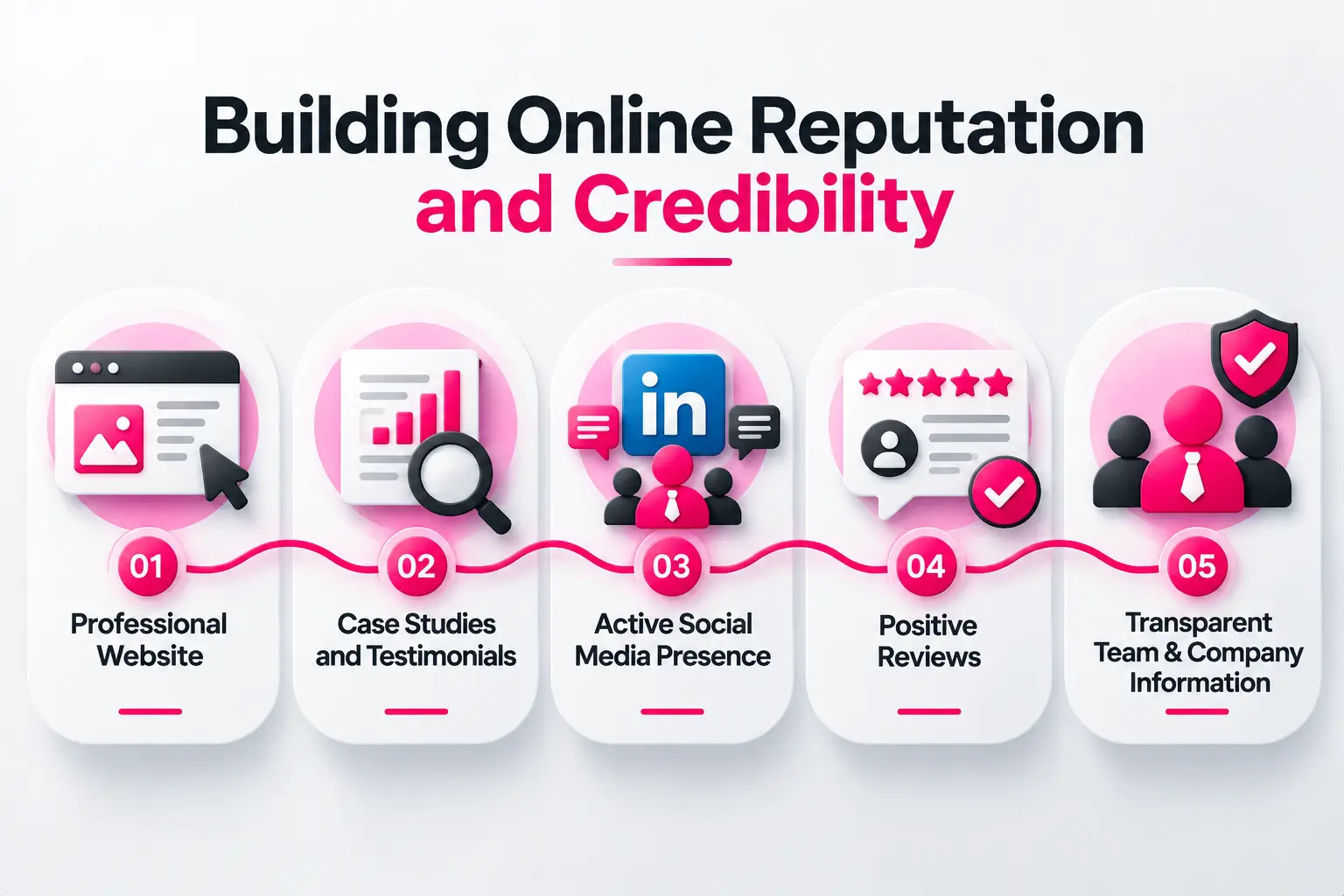
Before investing in lead generation, I believe your online presence must give prospects reasons to trust you. It must look real, active, clear, and supported by evidence.
The B2B Buyer’s Verification Habit
A potential client may see your company name in an email or LinkedIn message and immediately search for you. The research can happen before the prospect replies.
They may check:
- Your website and service pages
- Google search results
- LinkedIn and other social profiles
- Customer reviews
- Case studies and past results
- Company leadership and team information
- Industry directories and review platforms
This is the verification stage of the B2B buying process. Prospects are trying to confirm that your company is legitimate and capable.
For example, a software company receives a cold email from a digital marketing agency. Before booking a call, the software company may search the agency’s name, review its website, check LinkedIn activity, and look for client results.
If these sources show consistent information and real evidence, the prospect has fewer reasons to hesitate. If the website is outdated, reviews are missing, or the company has little online information, the same outreach may get ignored.
Website Essentials That Convert
Your website is often one of the first places a prospect goes after discovering your company. It should not only explain what you sell. It should also reduce questions and remove reasons for doubt.
A B2B website should make these details easy to find:
- What you offer: Explain your services in simple terms and show who they are for.
- How you work: Give prospects a clear view of your process, from the first conversation to delivery.
- Proof of results: Use case studies, client examples, testimonials, and measurable outcomes.
- What happens next: Make it clear how a prospect can contact you, request information, or schedule a conversation.
The goal is simple: your website should make the next step feel safe and clear.
If your pricing depends on project size, scope, or business needs, you do not always need to publish fixed prices. Instead, explain what affects the cost and what a prospect can expect during the quoting process.
Case Studies and Testimonials
Interest does not automatically create trust. A prospect may like your service but still ask, “Have you done this successfully for a company like mine?”
That is where case studies and testimonials become valuable.
A useful case study should tell a simple story:
Problem → Approach → Solution → Result
Instead of saying, “We provide SEO services,” a case study could explain how your team helped a B2B software company increase qualified organic leads over a specific period.
Strong case studies can include:
- The client’s industry
- The original business problem
- Your strategy or solution
- Key actions taken
- Measurable results
- The time period involved
Testimonials serve a different purpose. They show how real clients experienced your service.
Avoid making every testimonial sound like a generic statement such as “Great company and great service.” Specific comments about communication, results, expertise, or the buying experience carry more useful information.
Active, Consistent Social Media Presence
A prospect may visit your LinkedIn company page after receiving an outreach message. If the last post was published two years ago, it can create questions about whether the business is still active.
You do not need to publish content every day. Consistency matters more than volume.
For a B2B company, useful content may include:
- Client success stories
- Industry insights
- Practical tips
- New projects or company updates
- Employee or leadership posts
- Lessons learned from client work
- Original research and data
LinkedIn is especially useful for showing expertise and giving prospects more context about your company.
Your social profiles should also match your website. Use the same company name, services, basic business information, and branding where possible.
Review Platforms That Matter
Not every review platform has the same value for every B2B company. The right platforms depend on your industry and where your target buyers conduct research.
Common examples include Google Reviews, Clutch, and G2. A software buyer may look at G2, while someone searching for an agency or professional service provider may check Clutch or Google.
Focus on genuine reviews from real customers rather than trying to collect reviews in large batches.
When building your review profile, pay attention to:
- Review volume
- Review quality
- Recent activity
- Specific customer experiences
- Your responses to reviews
- Consistency across platforms
Team, Transparency, and Genuine Signals
B2B buyers are not only buying a product or service. In many cases, they are choosing a company they may work with for months or years. They want to know who is behind the business.
Give prospects enough information to see the real company behind the brand.
Consider showing:
- Leadership and key team members
- Company location or operating regions
- Business history
- Contact information
- Relevant certifications or partnerships
- Industry experience
- Clear information about your services
You do not need to reveal every internal detail. The goal is to remove unnecessary uncertainty.
For example, a website that clearly identifies its leadership, explains its services, shows real client work, and provides multiple ways to contact the company gives prospects more signals to verify.
Remember that transparency is especially important in B2B sales because trust often needs to exist before the first serious sales conversation.
Choosing Your B2B Marketing Mix
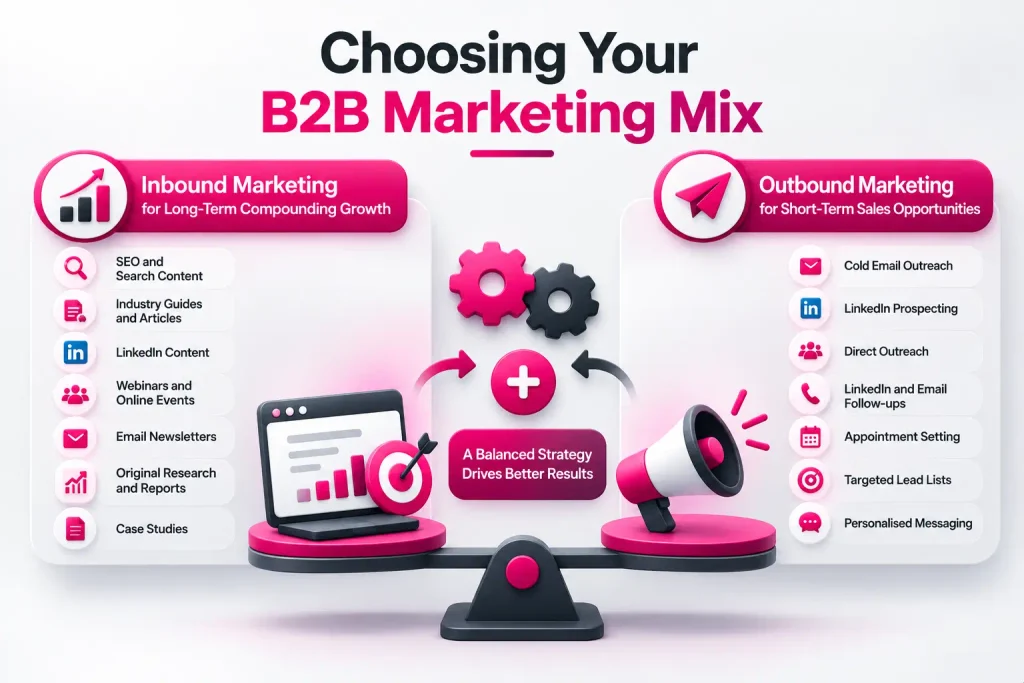
B2B client acquisition has two main engines: inbound and outbound marketing. In my view, they serve different timelines and work best when combined as part of a strong B2B lead generation strategy.
A balanced acquisition system can use both:
Inbound → Build long-term demand and visibility
Outbound → Create short-term sales opportunities
The right mix depends on your sales cycle, target market, budget, team, and growth goals.
Inbound Marketing for Long-Term Compounding Growth
Inbound marketing brings potential clients to your business through useful content, search visibility, social media, email, and other channels. Instead of contacting every prospect directly, you create resources that people can discover when they have a problem or need a solution.
Common B2B inbound channels include:
- SEO and search-focused content
- Industry guides and educational articles
- LinkedIn content
- Webinars and online events
- Email newsletters
- Original research and reports
- Case studies
The main advantage is that useful content can continue attracting prospects after it is published. A well-written article that ranks for an important search term may bring relevant visitors for months or years.
However, inbound usually takes time. So, think of inbound as building an asset. You need to build content, earn visibility, develop authority, and create enough trust for visitors to become leads.
Outbound Marketing for Immediate Pipeline
Outbound marketing starts with your business identifying potential clients and reaching out to them. Instead of waiting for prospects to discover you, your team starts the conversation.
Common outbound methods include:
- Cold email
- LinkedIn outreach
- Sales calls
- Account-based marketing
- Direct outreach to target accounts
- Industry events and networking
- Strategic partnerships
A good outbound process starts with targeting. Suppose you sell cybersecurity services to mid-sized financial companies. Your sales team could create a list of companies that fit your target profile and contact the relevant decision-makers with a specific message.
Outbound can create conversations faster than a new inbound channel, but speed does not guarantee results. Poor targeting, generic messages, weak offers, or excessive follow-ups can damage your reputation and waste sales time.
Inbound Marketing: SEO, Content, and Organic Channels
I see inbound marketing as reaching people already searching for information, solutions, or providers through search, content, LinkedIn, YouTube, and organic channels. The goal is not simply to get more traffic. It is to attract relevant prospects and give them useful information at different stages of the buying process.
SEO as the Long-Term Growth Engine
SEO gives your business a way to reach prospects when they are actively searching for answers, products, or services. This makes search especially useful for B2B companies with problems that buyers research online.
For example, a company looking for “B2B lead generation services” may already understand its problem and be exploring possible solutions. Ranking for that search puts your business in front of a relevant audience at the right moment.
A strong B2B SEO strategy can target:
- Commercial service keywords
- Problem-based searches
- Industry-specific questions
- Comparison searches
- Solution-focused queries
- Location-based searches, when relevant
SEO also supports other parts of your acquisition system. Prospects who receive an outbound message may search your company before replying. A strong organic presence gives them more information to review.
SEO takes time and requires ongoing work, but successful rankings can continue bringing qualified visitors without paying for every individual click.
Content Marketing and Topical Authority
Content marketing gives prospects useful information before they become customers. The best B2B content focuses on real questions and problems rather than simply promoting your services.
You can create content around the buyer journey, such as:
- Early stage: Educational guides that explain a problem or concept.
- Middle stage: Comparisons, checklists, and solution-focused articles that help prospects evaluate options.
- Late stage: Case studies, service pages, pricing information, and implementation guides that support buying decisions.
The key is to create content for the audience you want to attract.
For example, an accounting firm could publish content explaining how businesses can prepare for an audit, compare accounting software, and choose an outsourced accounting provider.
Over time, covering related topics in depth can build topical authority. It also gives prospects more opportunities to discover your company through different searches.
Organic Social Media Activity
Social media gives B2B companies another way to stay visible between searches and sales conversations. LinkedIn is especially useful because business owners, executives, marketers, and other professionals use it to follow industry discussions and discover companies.
Your goal should not be to publish promotional posts every day. Instead, share information that demonstrates knowledge and gives prospects a reason to remember your company.
Useful LinkedIn content can include:
- Industry opinions backed by experience
- Lessons learned from client projects
- Short how-to posts
- Data and research
- Case study insights
- Answers to common customer questions
- Behind-the-scenes company updates
Consistency matters. An active profile gives a prospect more context when they research your company.
Someone may receive an outbound email today, visit your LinkedIn page tomorrow, and see several useful posts about the exact problem mentioned in the email. That activity can strengthen recognition before the next sales conversation.
YouTube and Video Marketing
Video can make complex B2B products and services easier to understand. It also gives your company another searchable channel where prospects can discover your expertise.
Different types of videos can support different parts of the buying journey:
- Explainer videos: Explain a complex problem, service, or process.
- Demo videos: Show how a product or solution works.
- Case-study videos: Present customer problems, solutions, and results.
- How-to videos: Answer common questions and teach useful skills.
- Expert videos: Share insights about industry trends or common challenges.
For example, a software company could create a five-minute product demo showing how its platform solves a common workflow problem. A prospect who finds the video through search can understand the product before speaking with sales.
YouTube content can also appear in Google search results, giving your business another opportunity to reach potential buyers organically.
The strongest video strategy focuses on useful answers and proof, not polished production alone.
The New Frontier: Optimizing for AI Search (GEO/AEO)
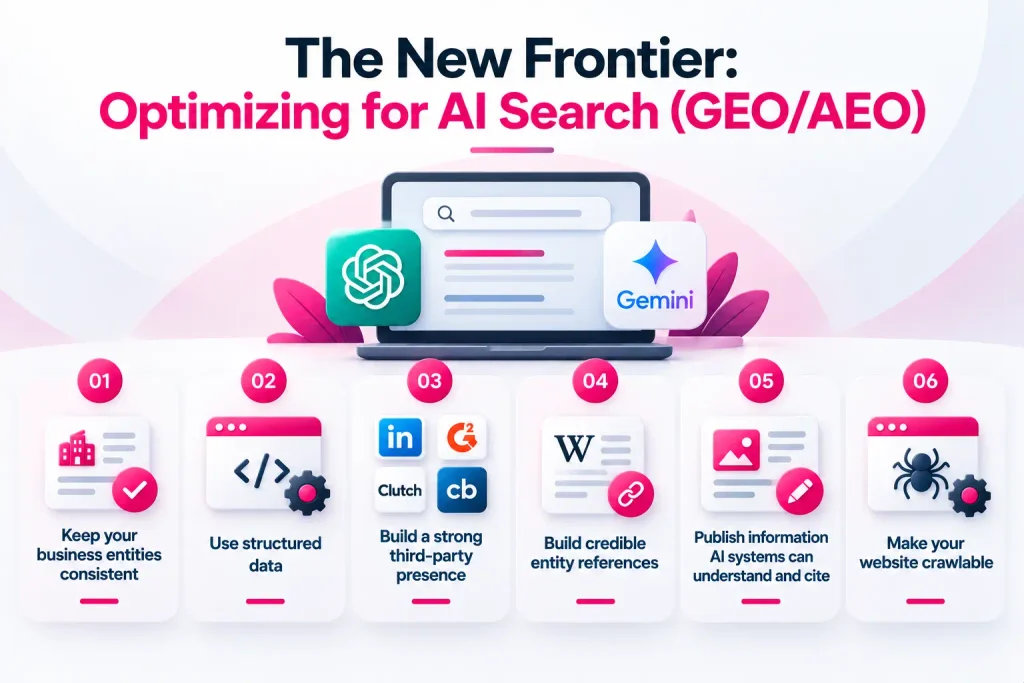
AI search is changing how buyers research B2B companies. I want my digital presence to provide clear, consistent information that helps AI tools understand and reference my business.
Practical Steps to Get Mentioned by ChatGPT and Gemini
AI search systems use different signals and can change how they select and cite sources. You can improve the information available about your business and make your online identity more consistent.
1. Keep your business entities consistent
Use the same company name, website, services, location, leadership information, and other important details across your website and trusted third-party profiles.
2. Use structured data
Structured data gives search engines additional information about what a page represents. For a business website, relevant markup may include information about the organization, services, people, and other entities where appropriate.
3. Build a strong third-party presence
Do not depend only on your own website to establish your company’s identity. Maintain accurate profiles on relevant business and industry platforms.
Depending on your company and market, these may include:
- G2
- Clutch
- Crunchbase
- Industry directories
- Professional associations
- Relevant publications
4. Build credible entity references
For established companies, a presence in knowledge sources such as Wikipedia or Wikidata may provide useful entity information. The better approach is to earn genuine references through notable work, publications, partnerships, research, awards, and other activities.
5. Publish information AI systems can understand and cite
Create clear pages that directly answer questions buyers ask. Include specific facts, original research, customer examples, definitions, comparisons, and useful explanations. This gives both human buyers and AI search systems more useful information to work with.
6. Make your website crawlable
Technical access matters. OpenAI states that allowing OAI-SearchBot to crawl a website helps make its content eligible for inclusion in ChatGPT search results.
Your SEO and technical teams should review robots.txt, indexing, page accessibility, internal links, and other technical issues that could prevent important pages from being discovered.
Outbound Marketing: Cold Email, LinkedIn Outreach, and Paid Ads
Outbound works best as a B2B outbound sales system. You need the right prospects, a relevant message, a reliable follow-up process, and a credible online presence. A cold message may start the conversation, but your website, reviews, case studies, and social profiles often shape what happens next.
Cold Email Outreach
Cold email gives you a direct way to reach potential clients who match your ideal customer profile. The first step is building a targeted prospect list, not collecting as many email addresses as possible.
Define details such as:
- Industry
- Company size
- Location
- Revenue range, if relevant
- Business problem
- Decision-maker or job role
- Technology or service needs
Your message should connect with a real business need. Personalization can include the prospect’s role, company situation, recent business activity, or a specific problem you believe your service can address.
Deliverability also matters. Use a properly configured sending domain, verify email addresses, control sending volume, and avoid spam-heavy language.
The goal of a cold email is usually not to explain everything. A short, relevant message should give the prospect a clear reason to continue the conversation.
LinkedIn Outreach
LinkedIn gives B2B teams another way to reach decision-makers while building familiarity around the company and its people.
A simple LinkedIn outreach process might look like this:
Connect → Engage → Start a relevant conversation → Share useful information → Move qualified prospects to a sales conversation
Do not treat every connection request as a sales pitch. A prospect may be more open to a conversation after seeing useful posts from your company or sales team.
Social selling can include commenting on industry discussions, sharing practical insights, responding to relevant posts, and sending direct messages when there is a clear reason to reach out.
For example, if a company recently expanded its sales team, a B2B sales training provider could mention that growth when starting a conversation. The message has context instead of feeling like a mass promotion.
Your LinkedIn profile also matters. Prospects may check your profile before responding, so make sure your role, company, experience, and relevant expertise are clear.
PPC and Meta Ads for B2B
Paid advertising can give your B2B company faster visibility while organic channels are still developing. Search ads can reach people actively looking for a solution, while social advertising can introduce your business to specific audiences.
PPC campaigns can target searches related to:
- Your core services
- High-intent commercial terms
- Specific solutions
- Competitor comparisons
- Industry-specific needs
Paid social campaigns can support awareness and retargeting. For example, someone may visit your service page after receiving an email but leave without contacting you. A properly configured retargeting campaign can bring your brand back in front of that visitor.
Paid advertising works best when the full journey is connected:
Ad → Relevant landing page → Trust signals → Clear offer → Conversion
Sending every visitor to your homepage can create unnecessary friction. A dedicated landing page that matches the ad’s message can give prospects a clearer path to the next step.
The Verification Moment
Sending a cold email or LinkedIn message is often only the beginning. After seeing your message, a prospect may search your company before deciding whether to reply.
For example, they may:
- Search your company name on Google.
- Visit your website.
- Review your services and process.
- Look for customer reviews.
- Check your LinkedIn activity.
- Read case studies or client stories.
- Search for evidence of previous work.
- Compare your company with other providers.
This is the verification moment. Your outbound campaign creates the first touchpoint, but your online presence often supports the prospect’s next decision.
Imagine receiving a cold email from an unfamiliar consulting firm. You click the sender’s website and find clear services, recent LinkedIn activity, strong client reviews, detailed case studies, and a real team page. That information gives you more context before you decide whether to respond.
How Trust and Channels Work Together
B2B client acquisition works best when your marketing channels and trust signals support each other. No single channel has to do everything. Each one can support a different part of the buyer journey.
A simple way to understand this system is:
Awareness → Verification → Trust → Interest → Conversion
The prospect moves through these stages in different ways. Some buyers may complete them in a few days, while others may take weeks or months.
The Buyer Journey Map
The buyer journey starts when a potential client becomes aware of your company. I see these connected stages as the foundation of a B2B sales pipeline, moving prospects toward a sales conversation.
1. Awareness
The prospect discovers your company or service. Your job is to become visible to the right audience.
2. Verification
The prospect checks whether your company is real and relevant. They may search your business name, visit your website, review LinkedIn, and look for customer feedback.
3. Trust
The prospect looks for evidence that you can deliver. Case studies, testimonials, reviews, certifications, team information, and useful content can support this stage.
4. Interest
The prospect starts paying closer attention. They may read more content, watch a demo, compare providers, join your email list, or respond to an outreach message.
5. Conversion
The prospect takes meaningful action, such as requesting a proposal, booking a meeting, starting a trial, or signing a contract.
Case Studies and Testimonials as Conversion Lever
Case studies and testimonials can act as the bridge between interest and action.
A prospect may already understand your service and believe that it could solve their problem. The remaining question is often: “Can this company actually deliver?” Proof gives them an answer.
A strong case study can show:
- What problem the client faced
- What solution your company provided
- How the work was carried out
- What changed after implementation
- Measurable results, when available
Testimonials add a personal perspective. They can show how clients experienced your communication, process, expertise, or results.
A B2B company may generate 100 leads through SEO and outbound campaigns. Those prospects can visit the website and show interest, but weak proof may cause many to delay the decision. Adding relevant case studies and specific client testimonials gives qualified prospects evidence to consider during the buying process.
Building Your B2B Client Acquisition System Step-by-Step
A B2B client acquisition system does not need to be built all at once. Start with the parts that affect trust, then add channels that bring qualified prospects into the system.
The order matters. Use these five steps to build a system that you can measure and improve.
Step 1: Audit and Fix Your Trust Infrastructure
Look at your business from a prospect’s point of view. Is it clear what you do? Can they understand who you serve? Can they find evidence of successful work? Does your online presence look current?
Start by checking what a potential client sees after discovering your company.
Review your:
- Website and service pages
- Case studies and testimonials
- Google and industry reviews
- LinkedIn and other social profiles
- Team and company information
- Contact details
- Search results for your company name
Fix major trust gaps before increasing your outreach or advertising. Your acquisition channels will perform better when prospects find a credible business after the first touchpoint.
Step 2: Define Your Ideal Client Profile
A clear ICP improves both inbound and outbound marketing. Your Ideal Client Profile (ICP) describes the type of company that is most relevant to your business.
An ICP can include:
- Industry
- Company size
- Location
- Revenue range
- Business model
- Common problems
- Buying triggers
- Typical decision-makers
- Budget or spending capacity
- Existing tools or solutions
For example, “B2B companies” is too broad for many campaigns. A more useful ICP might be “U.S.-based SaaS companies with 50–200 employees that need more qualified sales leads.”
Step 3: Launch Inbound Foundations
Once your target audience is clear, build channels that can attract prospects over time.
Start with the areas that match your audience and buying journey:
- SEO for relevant search terms
- Problem-solving content
- Service and solution pages
- Case studies
- YouTube and video content
- LinkedIn content
- AI-search optimization
Your content should answer the questions your ideal clients ask before they buy.
Do not create content simply to publish something every week. Focus on topics that connect to your services, customer problems, and commercial goals.
Step 4: Layer in Outbound for Immediate Pipeline
With your trust foundation and ICP in place, add outbound channels to create more direct sales opportunities. For businesses that need extra outbound capacity, an outsourced SDR alternative may also support prospecting and appointment setting.
Your outbound mix may include:
- Cold email: Reach carefully selected prospects with relevant messages.
- LinkedIn outreach: Connect with decision-makers and use useful content and direct conversations to build relationships.
- Paid advertising: Reach high-intent audiences and retarget people who have already interacted with your business.
Keep the campaigns focused. A smaller list of well-matched prospects can be more useful than a large list with weak targeting.
Also connect outbound campaigns to your inbound assets. A prospect who receives an email may visit your website, read a case study, check your LinkedIn profile, or search your company before replying.
Step 5: Track, Measure, and Optimize Across Channels
Do not judge a channel only by traffic, clicks, followers, or email opens. A channel that produces fewer leads may still create more customers or higher-value deals.
A client acquisition system needs measurement. Without tracking, it becomes difficult to know which channels create real business results.
Start with metrics such as:
- Customer Acquisition Cost (CAC): How much you spend to acquire a new customer.
- Reply rate: How many outreach recipients respond.
- Lead conversion rate: How many leads become qualified opportunities or customers.
- Cost per lead: How much you spend to generate each lead.
- Sales conversion rate: How many qualified opportunities become customers.
- Pipeline value: The potential revenue represented by active sales opportunities.
Review your numbers regularly and look for weak points.
If many people visit a service page but few contact you, review the page and offer. If cold emails get replies but few meetings, review your targeting or message. If meetings happen but deals rarely close, examine your sales process, offer, proof, and qualification.
How to Generate B2B Appointments
Generating B2B appointments starts with reaching the right prospects and giving them a clear reason to talk. The goal is not to book as many meetings as possible. It is to create qualified sales opportunities.
Start With the Right Prospects
Build a focused prospect list based on:
- Industry
- Company size
- Location
- Business needs
- Decision-maker role
- Potential fit
Use Multiple Outreach Channels
Reach prospects through cold email outreach, LinkedIn outreach, referrals, partnerships, and paid campaigns. Keep your message focused on the problem you solve and the value you offer.
Make the Next Step Simple
Give interested prospects a clear next step, such as a discovery call, consultation, or product demo. Avoid making the process complicated.
Follow Up Consistently
Many prospects will not respond to the first message. A consistent follow-up process helps you stay visible without sending repetitive or irrelevant messages.
Qualify Before the Meeting
Before booking an appointment, check the prospect’s:
- Business needs
- Budget or potential value
- Timing
- Decision-making role
- Fit with your services
Finally, track appointments booked, qualified meetings, attendance, and sales conversions. These numbers show which parts of your acquisition system need improvement.
Final Opinion
B2B client acquisition becomes harder when every channel works alone. More emails, posts, or ads will not solve a system that lacks trust, clear targeting, and consistent follow-up.
In my view, businesses should focus less on chasing leads and more on building a journey that makes prospects confident at every stage. Build credibility first, define your ideal client, combine inbound with targeted outbound, and measure what creates real opportunities.
ProspectOut can support the outbound side of this system through targeted prospect research, cold email outreach, LinkedIn outreach, lead qualification, and appointment setting. This gives businesses a structured way to reach qualified decision-makers and create more sales conversations.