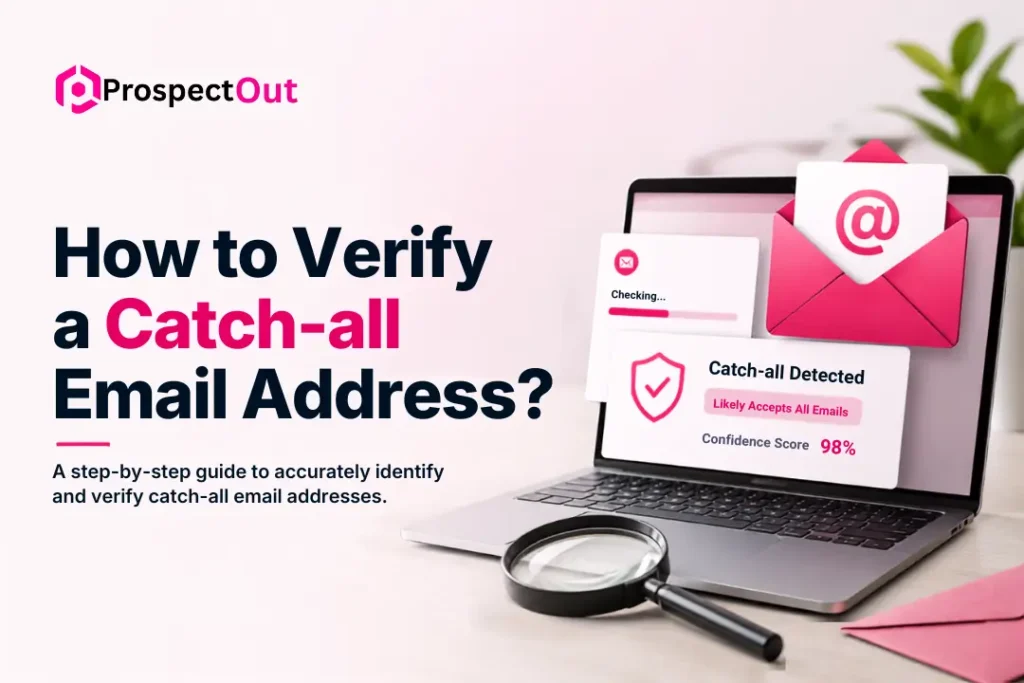
Few things create more uncertainty in cold email than a catch-all email address. A verification tool can’t confidently mark it as valid, but removing it from your list could mean missing a valuable opportunity.
That’s a challenge I’ve faced countless times while managing B2B outreach campaigns. Over the years, my team has refined a process that goes beyond software predictions and focuses on real delivery data. We’ve learned that the smartest decision isn’t to trust or reject every catch-all email—it’s to validate them differently.
In this article, I’ll show you the exact process we use, explain the limitations of email verification tools, and help you make better decisions when catch-all email addresses appear in your prospect list.
What Is a Catch-all Email Address?
A catch-all email address is an email address on a domain configured to accept messages sent to almost any recipient, even when the specific mailbox doesn’t exist.
Instead of rejecting an unknown recipient during the SMTP handshake, the mail server accepts the message and decides how to process it afterward. It may forward the email to a default inbox, route it internally, filter it as spam, or silently discard it.
For example, if john@company.com isn’t a real mailbox, a catch-all domain may still accept the message because its mail server is set up to receive emails for any address on that domain.
This is where many people get confused. A server accepting an email doesn’t necessarily mean the mailbox exists or that the message will reach an active inbox.
According to ZeroBounce’s 2026 Email List Decay Report, more than 9% of the 11+ billion email addresses it verified in 2025 were catch-all emails.
When my team reviews prospect lists before launching cold email campaigns, we pay close attention to catch-all domains for this reason. Email verification tools can confirm that the domain accepts mail, but they cannot reliably confirm the existence of the individual mailbox.
Why Catch-all Email Addresses Are Difficult to Verify
Catch-all email addresses are difficult to verify because the receiving mail server accepts emails for virtually any recipient on the domain. During an SMTP verification check, it doesn’t confirm the existence of the specific mailbox.
In our experience managing B2B cold email campaigns, this is the main reason catch-all addresses require extra evaluation. A validator can verify that the domain is active and accepting mail, but it cannot confidently verify the individual inbox.
As a result, most email verification tools return a Catch-all or Unknown status instead of a definitive Valid result.
The Different Results You Get From Email Validation Tools
Before deciding if an email address should remain in a campaign, my team looks beyond the overall verification score. We pay close attention to four common validation statuses that reveal different levels of deliverability risk and verification confidence:
Valid
The email address passed verification checks, and the mail server confirmed that the mailbox appears to exist. Although no verification guarantees delivery, this is generally the safest status for outreach.
Catch-all
The domain accepts emails for nearly any recipient, making it impossible to verify whether the individual mailbox exists. We usually evaluate these addresses further before including them in a campaign.
Unknown
The validator couldn’t determine the mailbox status because the mail server blocked verification requests, timed out, or used security settings that prevented a reliable verification result.
Invalid
The email address failed verification because the mailbox or domain doesn’t exist, contains formatting errors, or the mail server explicitly rejected the recipient. I always exclude these addresses from outreach campaigns.
Can Catch-all Email Verification Tools Be Trusted?
I often get this question from clients, and my answer is always the same: yes, but only if you understand their limitations.
Modern email verification tools do an excellent job of identifying invalid addresses, disposable emails, syntax errors, and inactive domains. They also use multiple signals to estimate the likelihood that a catch-all email is deliverable.
However, they can’t definitively confirm the existence of an individual mailbox on a catch-all domain because the receiving mail server intentionally hides that information.
This is why my team never treats a catch-all result as either automatically safe or automatically risky. Instead, we look at it as a confidence score that requires additional evaluation.
For professional B2B cold outreach, relying solely on a verification tool isn’t enough.
We combine verification results with other factors, such as prospect quality, domain reputation, and campaign risk, before deciding if a catch-all email belongs in the final sending list.
How Catch-all Email Verification Tools Work
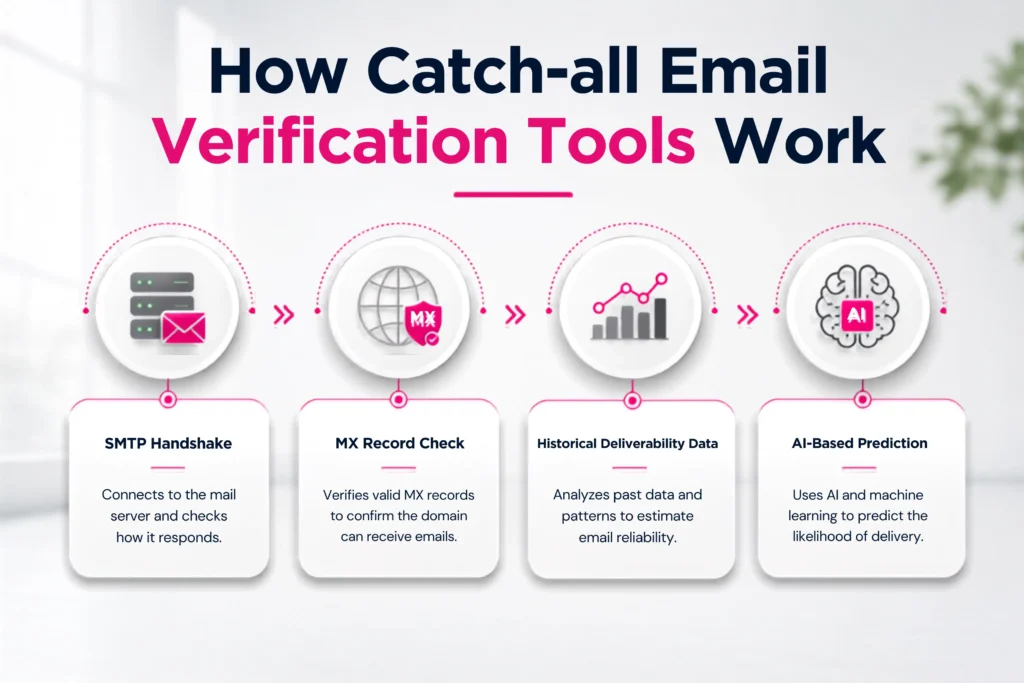
No email verification tool uses a single test to verify catch-all email addresses. Instead, most combine multiple techniques to estimate the likelihood that an email is deliverable:
SMTP Handshake
The tool communicates with the recipient’s mail server without sending an email. It checks how the server responds, but catch-all domains usually accept every recipient, limiting verification accuracy.
MX Record Check
The tool verifies that the domain has valid mail exchange (MX) records and is configured to receive emails. This confirms the domain is active but not the individual mailbox.
Historical Deliverability Data
Some providers analyze historical verification and delivery data to identify patterns associated with specific domains, helping them estimate the reliability of catch-all email addresses.
AI-Based Prediction
Many modern verification platforms use AI and machine learning to evaluate multiple signals and predict the likelihood of successful delivery when direct mailbox verification isn’t possible.
Manual Verification vs. Automated Tools: Which One Is Better?
Both manual verification and automated tools have a place in email verification. The right choice depends on your list size, available time, and the level of accuracy your campaign requires. Let’s compare both:
| Factor | Manual Verification | Automated Tools |
| Accuracy | This can provide additional confidence through research but still can’t definitively confirm every catch-all mailbox. | They produce fast, data-driven estimates using multiple verification signals. |
| Scalability | Practical for a small number of high-value prospects. | Ideal for verifying thousands or even millions of email addresses. |
| Time Investment | Requires significant time and manual research. | Processes large email lists within minutes. |
| Cost | Higher labor cost as lists grow. | More cost-effective for ongoing, high-volume outreach. |
| Best Use Case | Enterprise deals, strategic accounts, and highly targeted prospecting. | Regular B2B cold email campaigns, list cleaning, and ongoing lead generation. |
Our Manual Process for Verifying Catch-all Email Addresses
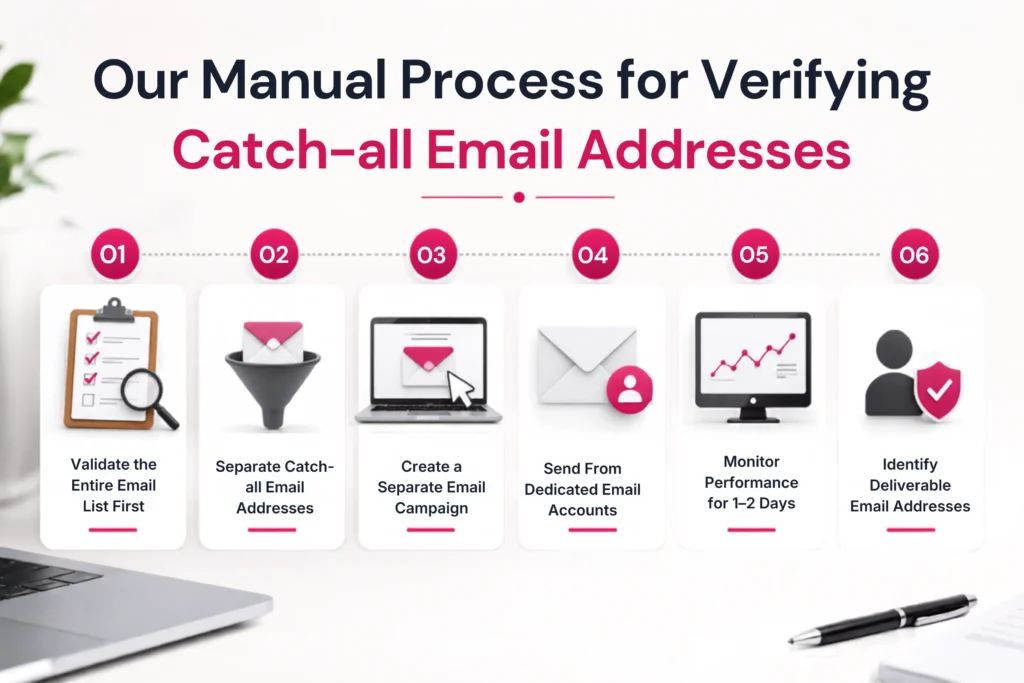
No email verification tool can confirm every catch-all email address with complete certainty. That’s why my team follows a structured manual process to identify deliverable catch-all emails while protecting our sending reputation:
1. Validate the Entire Email List First
We always begin by verifying the entire prospect list with an email validation tool. This removes invalid, duplicate, disposable, and poorly formatted email addresses before any manual review begins.
Starting with a clean list reduces unnecessary risks and allows us to focus only on catch-all addresses that require additional evaluation instead of spending time on emails that are already known to be undeliverable.
2. Separate Catch-all Email Addresses
(Screenshot of a spreadsheet filtered to display only email addresses with the “Catch-all” validation status.)
Once the verification process is complete, we export every email marked as Catch-all into a separate list. We never mix these contacts with fully verified prospects because they require a different approach.
Keeping them isolated allows us to control sending volume, monitor performance independently, and prevent uncertain addresses from affecting the overall health of our primary outreach campaigns.
3. Create a Separate Email Campaign
Instead of adding catch-all emails to an existing campaign, we build a dedicated campaign specifically for them. This gives us better visibility into delivery performance and makes it easier to evaluate results.
If a catch-all campaign experiences a higher bounce rate, it remains isolated and doesn’t impact campaigns targeting fully verified email addresses.
4. Send From Dedicated Email Accounts
We use separate email accounts for catch-all campaigns instead of our primary outreach accounts. Since these addresses carry more uncertainty, this extra layer of protection helps preserve the reputation of our main sending domains.
It’s a simple step, but it significantly reduces the risk of deliverability issues affecting high-performing campaigns.
5. Monitor Performance for 1–2 Days
After launching the campaign, we closely monitor performance during the first 24 to 48 hours. We look for hard bounces, reply activity, delivery trends, and other indicators that reveal how the list is performing. This monitoring period provides valuable data that no email verification tool can predict on its own.
6. Identify Deliverable Email Addresses
Based on the campaign results, we identify catch-all email addresses that consistently accept emails without generating hard bounces. Those contacts become part of our verified outreach database for future campaigns.
Any addresses that create delivery problems are removed, allowing us to improve list quality and maintain stronger deliverability over time.
Why Manual Verification Produces Better Results
From my experience managing B2B cold email campaigns, no verification tool can guarantee the accuracy of a catch-all email address because the receiving mail server limits the information available during the verification process.
That’s why I trust real campaign data more than software predictions. At ProspectOut, we use automated verification as the starting point, not the final decision.
My team then validates catch-all emails through carefully planned outreach campaigns using dedicated sending accounts. This lets us observe actual delivery behavior, bounce patterns, and engagement instead of relying only on estimated results.
Over the years, I’ve found that real sending data provides a more reliable way to identify deliverable catch-all email addresses while protecting our clients’ sender reputation.
Final Thoughts
If there’s one piece of advice I’d give after years of managing cold email campaigns, it’s this: don’t let a “Catch-all” status make the decision for you. A catch-all result only tells you that the receiving mail server accepts messages for the domain. It doesn’t confirm the mailbox exists, and it doesn’t predict what will happen after the email is accepted.
That’s why relying on SMTP verification alone isn’t enough. Real campaign performance, including hard bounce patterns, delivery consistency, and recipient engagement, provides far more meaningful validation.
When you combine technical verification with disciplined testing, catch-all email addresses become another opportunity to evaluate instead of a problem to avoid.
Frequently Asked Questions
Can a Catch-all Email Address Bounce?
Yes. A catch-all domain may accept an email during verification but still generate a hard bounce later if the server ultimately rejects the recipient.
Should I Remove All Catch-all Email Addresses From My Prospect List?
No. Automatically removing every catch-all email may eliminate valuable prospects. Instead, isolate them and validate them through a controlled outreach process before making a decision.
Do Catch-all Email Addresses Affect Sender Reputation?
Sending large volumes of unverified catch-all emails can increase hard bounces, which may weaken your sender reputation and reduce future email deliverability.
How Often Should I Reverify Catch-all Email Addresses?
Reverify catch-all email addresses before each major campaign or after several months. Mail server configurations and mailbox availability can change over time.