Most business brokers live with the same quiet anxiety: deal flow that comes in waves. A few good referrals, a busy quarter, then weeks of silence where the pipeline thins out and you’re back to chasing the same handful of contacts.
The supply of sellable businesses in any given market is finite, and every broker in the territory is competing for the same owners’ attention.
This is the story of how we fixed that problem for one business broker – not with a database of recycled names, but with a cold email system engineered from the ground up to put their name in front of the right business owners, at scale, month after month.
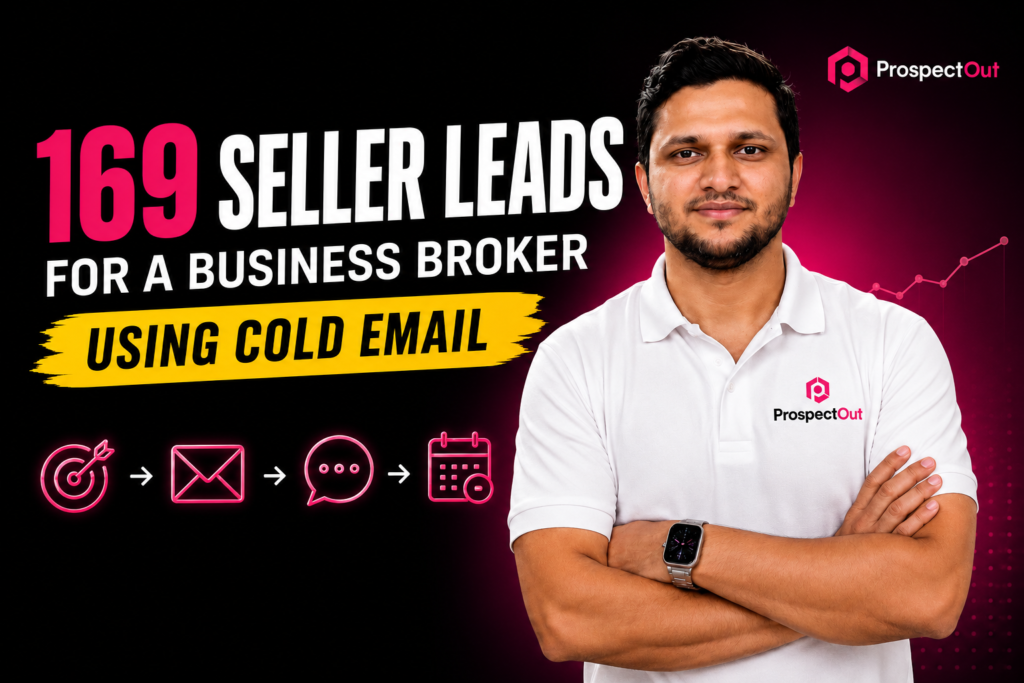
Over roughly five months, the campaign contacted around 15,000 prospects and produced 169 seller lead opportunities. Below is the full breakdown of how it was built, why each decision was made, and how the results compare to what’s realistic in cold email today.
The Headline Numbers
We launched on January 21st and let the campaign run for about five months. Here’s where it landed:
| Metric | Result |
|---|---|
| Prospects contacted | ~15,000 |
| Seller lead opportunities | 169 |
| Reply rate | 2.69% |
| Bounce rate | 1.54% |
| Open rate | Not tracked (intentional) |
| Campaign duration | ~5 months |
Two of these figures deserve immediate context, because on the surface they can be misread.
The reply rate is solid – here’s why
A 2.69% reply rate sounds modest until you look at where the broader market actually sits in 2026. Average cold email response rates have declined sharply over the past several years as inboxes have saturated and spam filters have tightened.
According to the 2026 Instantly benchmark report, which analyzed billions of cold email interactions, the platform-wide average reply rate now sits around 3.43%, down from roughly 5% in 2025 and 8.5% back in 2019.
Other large datasets put the typical B2B range even lower – many analyses peg the average B2B cold email response rate at a “pathetic” 1–3%, with the gap between average and excellent coming down to infrastructure and list quality far more than copy.
That context matters here for one specific reason: this campaign was selling a high-consideration service to business owners about the single biggest financial decision of their lives – selling their company.
That’s not a $49/month SaaS subscription someone replies to on impulse. A seller lead in this niche is worth thousands of dollars in potential commission, and the buying cycle is long.
Owners may spend months or years – evaluating their options before committing to a sale. In that environment, a 2.69% reply rate that produces 169 genuine seller conversations is a strong, commercially meaningful result.
The bounce rate is where the real discipline shows
Google, Yahoo, and Microsoft now enforce bulk-sender rules requiring bounce rates under 2% exceed that and you invite throttling, spam placement, or outright rejection. Our 1.54% bounce rate sits comfortably inside that line.
We hold a hard internal ceiling of 3% and aim well below it, because in cold email a high bounce rate isn’t just wasted sends – it’s a reputation signal that quietly tanks the deliverability of every email that follows.
We hit 1.54% by verifying every single email address with premium tools like NeverBounce before a campaign goes out. No exceptions, no shortcuts. This is the least glamorous part of the process and arguably the most important.
Why We Don’t Track Opens
You’ll notice the open rate above reads zero. That’s intentional, and it’s worth explaining because it cuts against what a lot of people expect from a campaign report.
Open tracking works by embedding a tiny invisible pixel in every email. When the recipient’s client loads that pixel, the open is recorded. The problem is twofold.
First, that pixel is itself a deliverability liability… it’s one more signal spam filters use to flag a message as bulk marketing rather than a genuine one-to-one email. Second, the data it produces is now largely fiction.
Apple Mail Privacy Protection automatically loads tracking pixels for every received email regardless of whether the user actually opened it, which means a large share of reported “opens” are phantom. Reported open numbers of 60–70% are now normal and tell you nothing about actual reader engagement.
So we make a deliberate trade: we give up a vanity metric in exchange for better inbox placement and we report on the only number that actually correlates with revenue – replies.
If an agency still leads its reports with open rates as the primary KPI, that’s worth asking about, because open rates flatter the numbers without indicating performance.
Part 1: The Infrastructure
Everything in cold email rests on whether your messages reach the inbox. You can write the best email in the world, but if it lands in spam, none of it matters. So before we sourced a single prospect, we built the sending infrastructure.
Domains and inboxes
We purchased 10 secondary domains and created 30 Google Workspace email accounts using our client’s name. Two principles drive this setup:
Protect the primary domain. We never send cold outreach from the client’s main business domain. Sending your first cold outreach from your primary domain is the classic rookie mistake… you protect your main brand by spinning up secondary domains dedicated to cold campaigns.
If a sending domain’s reputation gets damaged, it’s a domain we can retire, not the client’s actual business identity.
Spread the risk. Sending all emails from one domain concentrates reputation risk… if that domain gets flagged, everything stops. By distributing 30 inboxes across 10 domains, no single point of failure can take down the whole campaign.
The math behind the inbox count is straightforward. Experienced outbound teams cap cold sends at roughly 25 per mailbox per day to protect sender reputation; you divide your target daily volume by that number to determine how many mailboxes you need.
We held each inbox to around 25 emails per day — conservative by design. Pushing 50–60 per inbox is one of the fastest ways to trigger spam filters at Google and Microsoft.
Authenticity
Because the accounts were created in the client’s name, and because we send on the client’s behalf using their name and email signature, every conversation that starts feels personal and genuine… as it should. We’re not pretending to be someone else; we’re acting as the client’s outbound arm. A business owner who replies is replying to the broker.
The two-week warmup
Before a single cold email went out, we warmed up all the inboxes for about two weeks. A brand-new email account has zero sending reputation, and inbox providers treat unknown senders with suspicion.
Warmup gradually increases sending volume on a new mailbox to build sender reputation with providers like Gmail and Outlook… it’s the foundation of ongoing reputation, not a one-time step.
Two weeks is the practical minimum; best practice is to warm mailboxes for at least two weeks before sending cold emails and to keep warmup running continuously afterward.
Batch rotation: the long-game move
This is the piece that separates a campaign built to last from one built to burn out. We split the inboxes into two batches and rotate them: while one batch is actively sending, the other is warming up. Then they swap.
This matters because no domain can carry full sending pressure indefinitely without its reputation slowly eroding.
By rotating, we always have a “fresh” batch coming online while the active batch rests, which keeps deliverability strong across a campaign that runs for months rather than weeks.
Over a five-month campaign, that rotation is a large part of why the bounce and placement numbers held steady the whole way through rather than degrading after the first few weeks.
Part 2: The Prospect List
In cold email, list quality beats copy quality almost every time. The difference between top-performing accounts and average ones is not copy quality – it’s infrastructure plus list quality. Winners spend the majority of their time here.
For this campaign, we built a highly targeted list of business owners, CEOs, founders, and other decision-makers – the people who actually control the decision to sell a company.
We sourced them from a mix of platforms: LinkedIn, Apollo, and Google Maps. Using multiple sources rather than one matters, because single-source lists tend to carry 15–25% bounce rates that destroy reputation.
Multi-source building plus rigorous verification is how we got the bounce rate down to 1.54%.
Then we verified every address through several premium verification tools before importing. This double layer careful sourcing, then independent verification — is the unglamorous engine behind the whole campaign’s deliverability.
It’s also worth naming what we didn’t do: we didn’t buy a static database of “business broker leads” and blast it. Lead databases sell static lists of company owners with no context on sell intent or readiness to engage, and those lists are typically sold to multiple brokers at once.
A custom-built, verified list reaching owners on the client’s behalf is a fundamentally different and more defensible asset.
Part 3: The Email Copy
Once the list was ready, we wrote the sequence and shared everything with the client before launch — list, copy, and campaign structure — so it reflected their voice and they approved every word going out under their name.
The copy philosophy is deliberately minimalist:
Keep it short. Most emails ran under 100 words. The data backs this: messages around 50–125 words and under 200 total correlate with higher response, and shorter consistently outperforms longer. Short, conversational, straight to the point.
Strip out anything that trips filters. We avoid links, images, and attachments in the initial outreach. Links, images, GIFs, and attachments all hurt deliverability by triggering spam filters, so a plain-text email that reads like a note from one person to another both lands better and feels more human.
Use Spintext. We use spin syntax to make every email slightly different from the last, so we’re never sending thousands of byte-for-byte identical messages — a pattern that providers recognize and penalize. Spintax randomizes specific words and phrases so automated emails sound unique rather than mass-produced.
Test continuously. We A/B test subject lines, offers, and messaging angles throughout the campaign to find what resonates with this specific audience.
The angle that works for a manufacturing owner near retirement isn’t necessarily the one that works for a founder eyeing an exit after a growth plateau, and the only way to know is to test against real replies.
Part 4: Handling Replies and Delivering Leads
A reply is the beginning of the work, not the end of it. How leads get handled from there depends on what the client wants.
Every client gets access to the sending dashboard, where they can watch campaign performance in real time and respond to interested prospects directly. For brokers who’d rather stay entirely focused on valuations, negotiations, and closings, our team can manage the replies and book qualified meetings straight into their calendar instead. It comes down to the plan they choose: hands-on or fully hands-off.
This flexibility matters in the broker niche specifically, because business sales rarely happen quickly and the work rewards consistent, low-pressure follow-up over months. A reply today might be a listing six months from now, and the system is built to keep those conversations alive.
What This Campaign Actually Proves
Stepping back, the 169 seller leads aren’t the result of one clever trick. They’re the compounding output of a system where every layer reinforces the next:
- Infrastructure that keeps emails landing in the primary inbox – 10 domains, 30 inboxes, conservative sending, two-week warmup, and continuous batch rotation.
- List quality that puts the right offer in front of the right decision-makers, verified to a 1.54% bounce rate.
- Copy that’s short, human, filter-safe, and continuously tested.
- Reply handling that turns conversations into booked meetings and, eventually, signed listings.
Get any one of these wrong and the numbers collapse. A perfect email to an unverified list bounces. A great list sent from a cold, unwarmed domain lands in spam. Flawless infrastructure carrying a generic, link-stuffed email gets ignored. The result comes from running all four together, with discipline, over five sustained months.
For a business broker, the practical meaning is simple: instead of waiting for referrals and riding the feast-or-famine cycle, you get a predictable, repeatable engine that surfaces motivated sellers every single month — and a name that’s already in the inbox before the competition even knows the owner is thinking about selling.
This case study is based on a real ProspectOut campaign. Reply rates, bounce rates, and lead volume reflect the actual results over the campaign period. Cold email performance varies by industry, offer, and market conditions; these numbers represent one campaign in the business broker niche and are not a guarantee of specific outcomes.
Want to see what this could look like for your brokerage?
If you’d like to walk through the full process, pricing, and client testimonials, check Lead Generation Service for Business Brokers – or book a call to talk through your own pipeline.