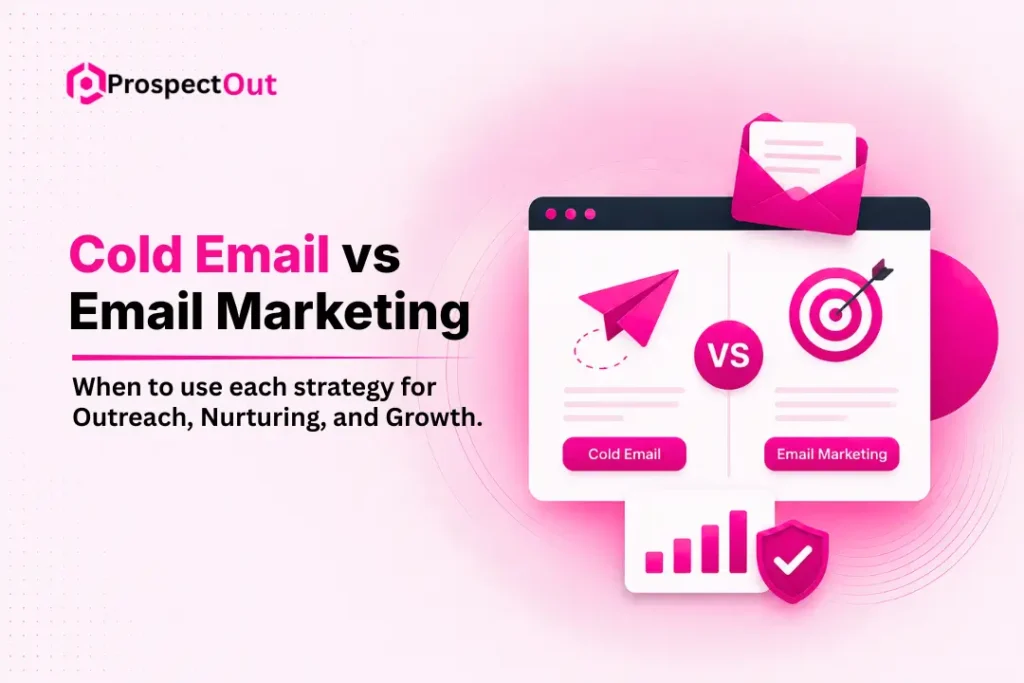
Cold email and email marketing are two very different tools that serve completely separate purposes in a business growth strategy.
Cold email reaches out to people who have never heard of you, while email marketing speaks to an audience that already signed up to receive your content.
In 2025, the average cold email reply rate sat at just 4.5%, while email marketing delivered an average click rate of 2.09% and an open rate of 43.46%.
Choosing the wrong approach wastes time, burns budget, and damages your sender reputation. So, let’s find which tool belongs in your strategy.
Cold Email vs Email Marketing: Core Differences
Here is a clear side-by-side look at how these two email strategies compare across the most important factors:
| Factor | Cold Email | Email Marketing |
| Audience | Unaware prospects | Opted-in subscribers |
| Intent | Start new relationships | Nurture existing ones |
| Consent | Not required (within law) | Explicit opt-in needed |
| Volume | Small, targeted lists | Large subscriber bases |
| Tone | One-on-one conversation | Brand broadcast voice |
| Primary Goal | Book calls, get replies | Drive clicks, purchases |
| Avg. List Size | 50–500 contacts/campaign | 500–500,000+ contacts |
| Main Metric | Reply rate | Click-through rate |
| Frequency | 3–5 follow-up sequence | Weekly or monthly sends |
Cold Email Outreach Explained
Cold email is a direct outreach method where you send a message to someone who has never interacted with your brand before. Sales reps, recruiters, and founders use it to open doors with prospects who would otherwise never discover their product or service.
A good cold email is short, direct, and highly relevant to the person receiving it. It feels like a one-on-one message from a real person, not a broadcast blast sent to thousands of contacts at once.
You research each recipient, craft a specific message that speaks to their situation, and send it with one clear ask. It produces the best results when your target fits your ideal customer profile and your offer solves a real problem they are facing right now.
Email Marketing Defined
Email marketing sends messages to a list of people who actively chose to hear from your brand. They opted in through a signup form, a product purchase, or a free resource download, which means they already have a reason to trust you.
These emails build relationships over time through product updates, promotions, tips, and stories that are relevant to the subscriber’s interests. The tone is less personal than cold outreach but remains focused and valuable enough to keep readers engaged.
Unlike cold outreach, email marketing benefits from an audience that already trusts you to some degree. That existing trust makes it significantly easier to drive clicks, sales, and repeat business over the long run.
Who Are You Sending To? Prospects vs. Subscribers
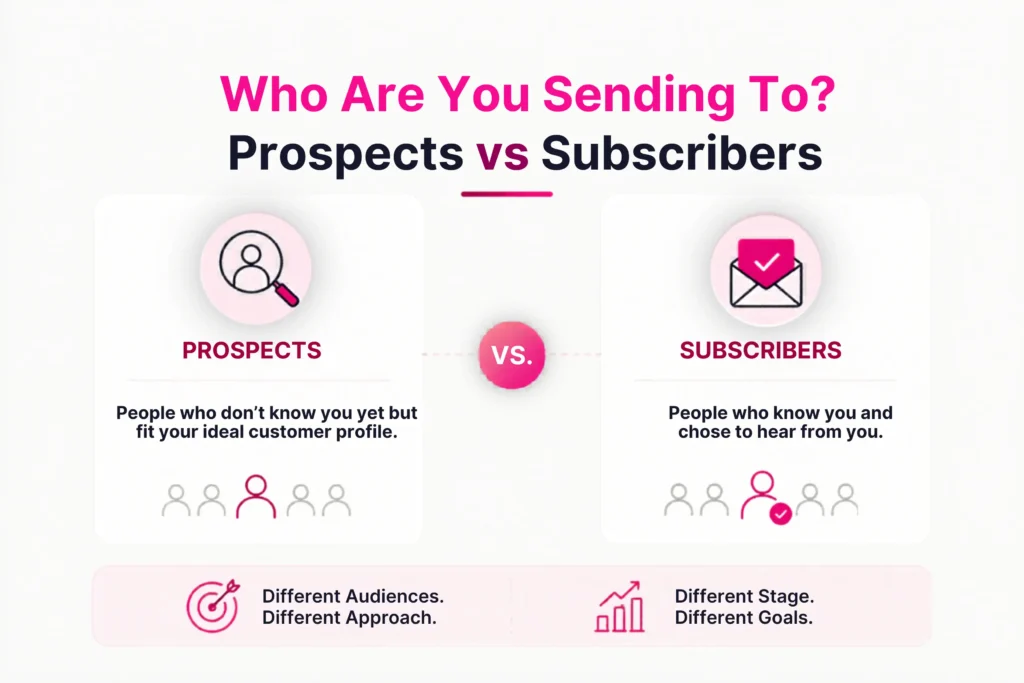
Cold email and email marketing speak to two completely different audiences at two different stages of awareness.
Cold Email Targets Prospects:
- People who have never heard of your brand but match your ideal buyer profile.
- Built through manual research, lead databases, or LinkedIn prospecting.
- Have never asked to hear from you, so every word must earn their attention fast.
- Require a highly specific, relevant message to prompt any response.
Email Marketing Targets Subscribers:
- People who actively gave you their contact details through a form, purchase, or download.
- Already familiar with your brand and what you offer.
- Far more likely to engage since they chose to be on your list.
- Respond better to consistent, value-driven content over time.
Goals and Intent: Pipeline Generation vs. Lead Nurturing
Each channel enters the conversation at a different stage of the buyer journey and serves a completely different commercial purpose.
Cold Email Goals:
- Prompt a reply that opens a real sales conversation with a qualified prospect.
- Book a meeting, demo, or discovery call with a decision-maker.
- Secure a direct response that moves an opportunity forward in your pipeline.
- Success is measured the moment someone says yes to the next step.
Email Marketing Goals:
- Stay top of mind with subscribers who are not yet ready to make a purchase.
- Deliver consistent value through education, tips, and relevant content over time.
- Guide leads through a longer journey that builds trust before a buying decision.
- Convert and retain customers who are already somewhere inside your funnel.
Message Style: Personalized Outreach vs Mass Campaigns
B2B cold emails must feel deeply personal, with each message referencing something specific about the recipient such as their company, their role, or a recent event relevant to their business. Generic messages that could be sent to anyone get ignored, deleted, or reported as spam before they ever generate a reply.
Email marketing uses a campaign style where one message reaches hundreds or thousands of subscribers at once. Personalization still plays a role through first names or behavioral segmentation, but the core message stays consistent across the entire audience.
Both styles demand strong, intentional writing that respects the reader’s time. Cold email requires surgical precision and brevity, while email marketing rewards creative storytelling and visual structure that guides the reader toward a clear action.
Legal Rules: CAN-SPAM and GDPR Compliance
Both cold email and email marketing must comply with legal frameworks that protect recipients from unwanted or deceptive messages, especially when sending cold emails without permission. In the United States, CAN-SPAM governs commercial email and requires a clear sender identity, a physical address, and a straightforward way for recipients to opt out.
Cold email can be sent without prior consent under CAN-SPAM as long as you follow those rules and honor removal requests without delay. GDPR, which applies across Europe, is considerably stricter and requires explicit consent before most commercial emails can be sent.
Breaking these rules results in fines, domain blacklisting, and serious damage to your sender reputation. Always include an unsubscribe link, never purchase lists of unverified addresses, and verify the compliance requirements for every region you plan to target.
Tools for Cold Email vs Email Marketing Platforms
Using the wrong tool for the wrong job is one of the most common and costly mistakes in email strategy.
Top Cold Email Tools:
| Tool | Best For | Standout Feature |
| Instantly | High-volume outreach | Unlimited email account rotation |
| Lemlist | Personalized sequences | Image and video personalization |
| Smartlead | Agency-scale campaigns | Advanced inbox warm-up system |
Top Email Marketing Platforms:
| Tool | Best For | Standout Feature |
| Mailchimp | Small to mid-size businesses | Easy drag-and-drop editor |
| Klaviyo | E-commerce brands | Deep purchase behavior segmentation |
| ActiveCampaign | Automation-heavy workflows | CRM and email combined in one platform |
What Each Type of Tool Is Built To Do:
- Cold email tools focus on deliverability, account rotation, domain warm-up, and reply tracking.
- Email marketing platforms prioritize design, list segmentation, A/B testing, and campaign analytics.
- Cold email tools connect to sales CRMs, while marketing platforms connect to e-commerce stores.
Key Metrics: Reply Rate vs Click-Through Rate
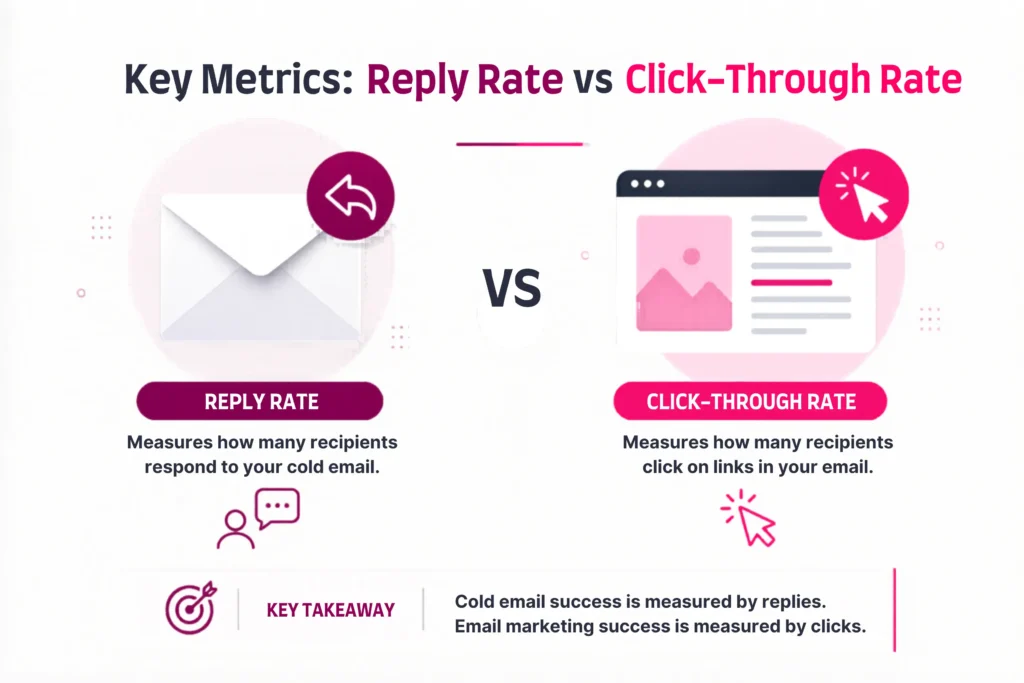
Cold email success is measured primarily by reply rate. In contrast, email marketing tracks click-through rate, open rate, unsubscribe rate, and conversion rate across each campaign.
Cold Email Metrics to Track:
| Metric | What It Tells You | Benchmark |
| Reply Rate | How well your message resonates | 5–10% is solid |
| Open Rate | How effective your subject line is | 40–60% is healthy |
| Meeting Booked Rate | How strong your call to action is | 1–5% is strong |
| Bounce Rate | How clean your contact list is | Below 5% is ideal |
Email Marketing Metrics to Track:
| Metric | What It Tells You | Benchmark |
| Click-Through Rate | How compelling your content and offer are | 2–3% industry average |
| Open Rate | How effective your subject line and sender name are | 20–40% is healthy |
| Unsubscribe Rate | How well your content matches audience expectations | Below 0.5% is safe |
| Conversion Rate | How well your emails drive purchases or signups | Varies by industry |
Scalability: Targeted Lists vs Large Subscriber Bases
Cold email scales through higher volume sent to carefully targeted lists, with most senders managing between 200 and 500 emails per day per inbox. Adding more sending accounts increases your reach, but quality always matters more than raw volume since a small, well-researched B2B prospect list consistently outperforms a massive generic one.
Email marketing scales effortlessly to enormous audiences because sending to 100,000 subscribers costs only marginally more than sending to 1,000. The real challenge is keeping that list healthy through regular cleaning, smart segmentation, and re-engagement campaigns for contacts who have gone quiet.
Both channels can scale significantly when managed with care and strategy. Your growth plan should clearly define how large each list needs to be in order to consistently hit your revenue and pipeline targets each quarter.
Content Format: Short Outreach vs Newsletters and Promotions
The format of your email tells the reader exactly what kind of relationship you have with them before they even finish the first sentence.
Cold Email Format:
- 3 to 5 focused sentences is all you need to generate a reply from the right prospect.
- Plain text only, no images, no branded headers, no fancy design.
- One clear value point followed by one direct call to action.
- Long walls of text signal you care more about talking than solving, which kills response rates.
Email Marketing Format:
| Type | Purpose | Style |
| Newsletter | Share tips, stories, updates | Long-form, editorial, conversational |
| Promotional Email | Drive sales, announce offers | Visual-heavy, bold CTAs, concise copy |
| Welcome Sequence | Introduce your brand | Warm, structured, multi-email series |
| Re-engagement Email | Win back inactive subscribers | Direct, value-led, single clear offer |
Timing and Frequency: Follow-Ups vs Scheduled Campaigns
Cold email timing follows the rhythm of the prospect, with most sequences built around three to five follow-up messages spread across 2 to 3 weeks. Follow-ups should introduce a new angle or add fresh value each time, rather than simply asking if the person happened to see your previous message.
Email marketing runs on a predictable schedule that subscribers come to expect and rely on over time. Weekly newsletters go out on the same day each week, monthly promotions drop at the start of the month, and that consistency builds the kind of trust that keeps open rates strong.
Frequency must always match what your audience is willing to tolerate at a given stage in their relationship with your brand. Monitor unsubscribe rates closely, since a sudden spike is often the clearest sign that you are sending too much, too fast, without enough value to justify the contact.
Use Cases for Cold Email and Email Marketing
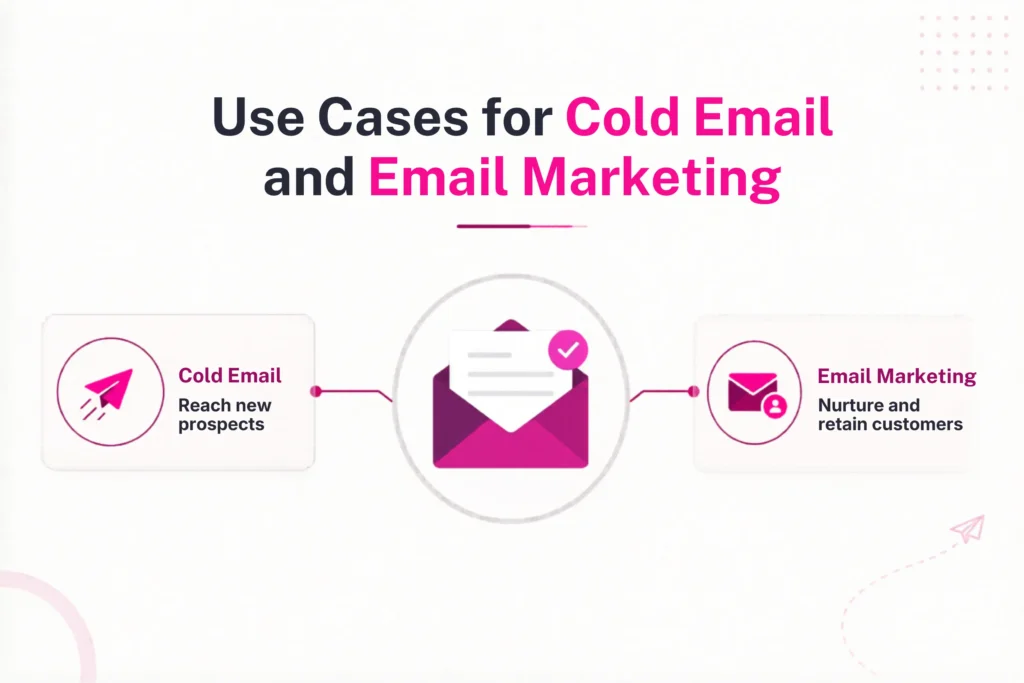
Both strategies serve distinct roles in a business growth plan. Here is how each one performs in real-world scenarios:
Cold Email in B2B Growth
B2B companies rely on cold email to reach decision-makers directly without waiting for inbound interest to build organically. A SaaS startup might send cold emails to HR directors at mid-size companies, while a marketing agency targets e-commerce brand owners who fit a specific growth profile. Cold email skips gatekeepers and generates meetings, demos, and pilot deals at a pace that most inbound channels simply cannot match.
Email Marketing in Customer Retention
Retaining existing customers costs far less than acquiring new ones, and email marketing is the most reliable tool for making that happen. A brand sends onboarding sequences, product education tips, loyalty rewards, and re-engagement campaigns that keep buyers active and connected to the product over time. Repeat purchases and referrals rise consistently when customers feel genuinely valued and well-informed throughout their entire journey.
How Cold Email Helps Businesses Grow Faster
Cold email is one of the fastest and most direct paths to new revenue for businesses at any stage. Here is how it drives real growth:
- Direct access to decision-makers means you don’t have to wait for organic traffic or scale paid ads first.
- Faster meeting generation compared to most inbound channels gives your team a steady, reliable pipeline.
- Lower costs than paid advertising make it ideal for businesses working with tight budgets.
- Quick market testing allows you to validate new offers without heavy upfront investment.
- Increased brand awareness happens even when prospects don’t respond to your outreach.
- Automation and sequencing free up your team to focus on real conversations instead of manual sending.
- Valuable feedback comes through replies and objections, helping refine your offer and messaging.
Final Thought
Cold email and email marketing both work extremely well when used for the right purpose and aimed at the right audience. Cold email starts conversations with new prospects, often with help from a B2B cold email outreach company, while email marketing builds relationships with existing customers.
The mistake most businesses make is treating them as interchangeable, when in reality they serve completely different functions at different stages of the customer journey. Use cold email to find new customers, then use email marketing to retain and convert the ones you already have.
Run both channels with the right tools, the right metrics, and content that delivers real value. Done consistently, your email strategy becomes one of the most powerful growth engines your business has ever built.