
Reaching out to prospects can feel like a careful balancing act, especially when the goal is to generate interest without coming across as intrusive or annoying. Many B2B companies struggle with this because they focus heavily on volume while overlooking how their messages are perceived.
In our professional experience managing cold email outreach and appointment setting campaigns, we have seen that engagement improves when every message feels intentional, relevant, and respectful of the reader’s time.
Here, we explain what creates spam, why it damages outreach performance, and how to engage prospects in a way that builds trust and drives conversations.
What Creates Spam in Outreach
Spam is not only about sending too many emails, as it is more often the result of poor targeting, weak messaging, and lack of relevance. Things that create spam include:
Irrelevant Messaging
We often see companies send the same message to a wide audience without checking if the offer fits the recipient’s needs, which leads to weak engagement and missed replies. In our campaigns, relevance drives results, and when prospects do not see a clear link to their situation, they simply ignore the message.
High Volume Without Strategy
Sending large volumes without a clear structure rarely delivers strong outcomes, because email providers monitor engagement signals like opens and replies closely. When interaction stays low, inbox placement drops, and future emails struggle to reach prospects, making volume driven outreach ineffective and difficult to recover over time.
Poor Personalization
Adding a first name alone does not create a real connection, and we have tested this across many campaigns with consistent findings. Strong personalization reflects awareness of the company, role, or recent activity, which signals effort and increases trust, leading to better engagement and more meaningful responses from prospects.
Misleading Subject Lines
Short term gains from click driven subject lines often result in long term damage, because prospects quickly lose trust when the content does not match expectations. In our experience, repeated use of misleading hooks leads to lower open rates over time, as recipients begin to ignore or filter out future emails.
Lack of Relevance Signals
Cold outreach performs best when there is a clear and logical reason for contact, which we always prioritize in our campaigns. Messages that lack strong relevance signals feel random and intrusive, while focused targeting based on industry, role, or timing consistently leads to higher engagement and better quality conversations.
Why Spam Hurts Your Outreach Results
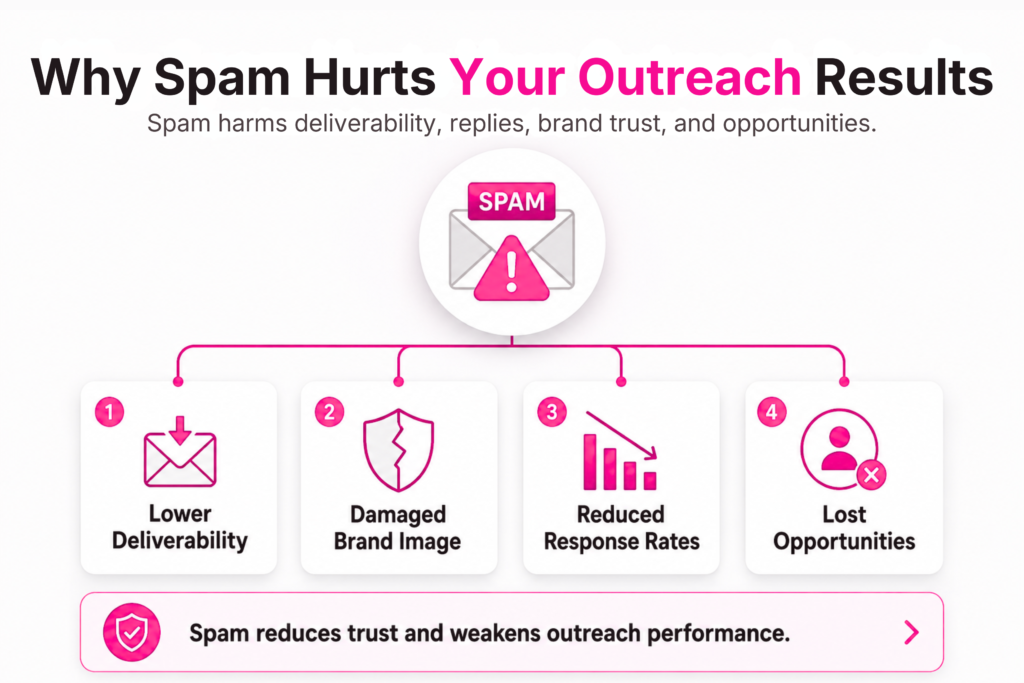
Spam affects more than just perception, as it directly impacts your ability to generate leads and build a strong pipeline. So let’s check how it influences deliverability, response rates, and overall outreach performance:
- Lower Deliverability: Poor engagement lowers inbox placement because email providers track recipient behavior closely.
- Damaged Brand Image: Careless or irrelevant messages quickly create a negative first impression.
- Reduced Response Rates: Unclear or irrelevant emails often fail to get responses from prospects.
- Lost Opportunities: Ignored messages mean missed conversations and slower growth over time.
The Psychology Behind Prospect Engagement
The psychology behind prospect engagement plays a major role in outreach performance in real campaigns. Effective outreach is rooted in understanding how people respond to communication in a professional setting, especially when their time is limited and attention is selective.
We noticed, a value first approach consistently delivers stronger results. Messages that focus on solving a real problem outperform those centered on selling a service. Prospects care more about their own challenges than any offer presented to them.
Clarity also builds trust in a meaningful way and clear communication helps prospects quickly understand intent. We have found that simple language leads to higher engagement compared to complex wording that creates friction or confusion.
Timing of sending emails matters as well in outreach success. Campaigns perform better when they align with recent company activity. This makes the message feel relevant and connected to current priorities.
How to Engage Prospects Without Spamming
Engagement improves when each message feels relevant, concise, and purposeful. Here’s how we consistently apply this approach in our outreach:
1. Research Your Prospects
We always begin campaigns with detailed research because understanding the prospect’s context shapes everything that follows in outreach. Studying industry, role, recent updates, and likely challenges helps build communication that feels relevant from the first line.
This approach reduces irrelevant messaging and increases the chance of replies because prospects immediately recognize relevance. It also improves targeting quality, which leads to stronger list accuracy and better overall performance.
To make research practical and fast, we usually break it into simple steps:
- Check the company website for services and positioning.
- Look at LinkedIn profile for role and seniority.
- Review recent posts or company updates.
- Identify possible pain points based on industry trends.
- Note hiring activity or growth signals.
- Observe competitors and market positioning.
- Match findings with a clear outreach angle.
2. Write Human Messages
When messages sound scripted, prospects tend to lose interest within seconds and move on. A natural tone makes outreach feel like a real exchange instead of a mass campaign. Simple language, short phrasing, and smooth flow make reading effortless.
It increases response rates because prospects feel they are interacting with a real person rather than a template.
To keep messages human and natural, these practices are followed in every campaign:
- Write like a normal one-to-one conversation.
- Avoid overly formal or robotic phrasing.
- Use simple words instead of complex expressions.
- Keep sentences easy to read at first glance.
- Focus on clarity instead of sounding “salesy”.
- Remove unnecessary filler words or buzz terms.
- Make the message feel direct and genuine.
3. Focus on One Idea
It is encouraged because multiple points in a single message dilute attention and reduce clarity. When too many ideas compete, the reader struggles to understand the main purpose and often ignores the message entirely.
A single clear direction makes it easier for prospects to process information and decide quickly. This structure also improves consistency in outreach because every email has a defined goal. Focused messaging consistently leads to higher engagement and better reply rates.
4. Keep It Concise but Meaningful
Overly long emails often get skipped even when the offer is relevant. A strong message delivers enough context to create interest without overwhelming the reader. The goal is clarity with minimal friction. When emails are easy to scan and understand quickly, engagement improves because decision-making becomes faster and less effort is required from the prospect.
5. Use Clear Calls to Action
We always use clear calls to action because prospects need direct guidance on what to do next. Unclear or vague requests often lead to no response even when interest exists. A clear CTA removes hesitation and creates a smooth path for conversation. When the next step is obvious and easy, reply rates increase naturally.
Some simple CTA examples that work well in outreach:
- “Are you open to a quick chat this week?”
- “Would it make sense to explore this further?”
- “Should I share a few ideas on this?”
- “Is this something you are looking into right now?”
- “Can I send more details?”
- “Would you be open to a short call next week?”
6. Respect Follow Ups
Repeating the same message too often reduces interest and can create frustration. Each follow up should introduce something new, such as additional context or a different angle, to maintain relevance.
Proper spacing also helps avoid pressure and keeps communication professional. Thoughtful follow ups improve engagement because they feel respectful and give prospects multiple natural chances to respond.
A simple follow up structure that works well in practice:
- Send 4 to 6 follow ups per campaign.
- Keep a gap of 2 to 4 days between each email.
First follow up: light reminder with slight rewording.
Second follow up: add new value or insight.
Third follow up: introduce a different angle or use case.
Fourth follow up: keep it short and direct.
Final follow up: polite close or break-up message.
Building a Clean and Scalable Outreach System for Consistent Engagement
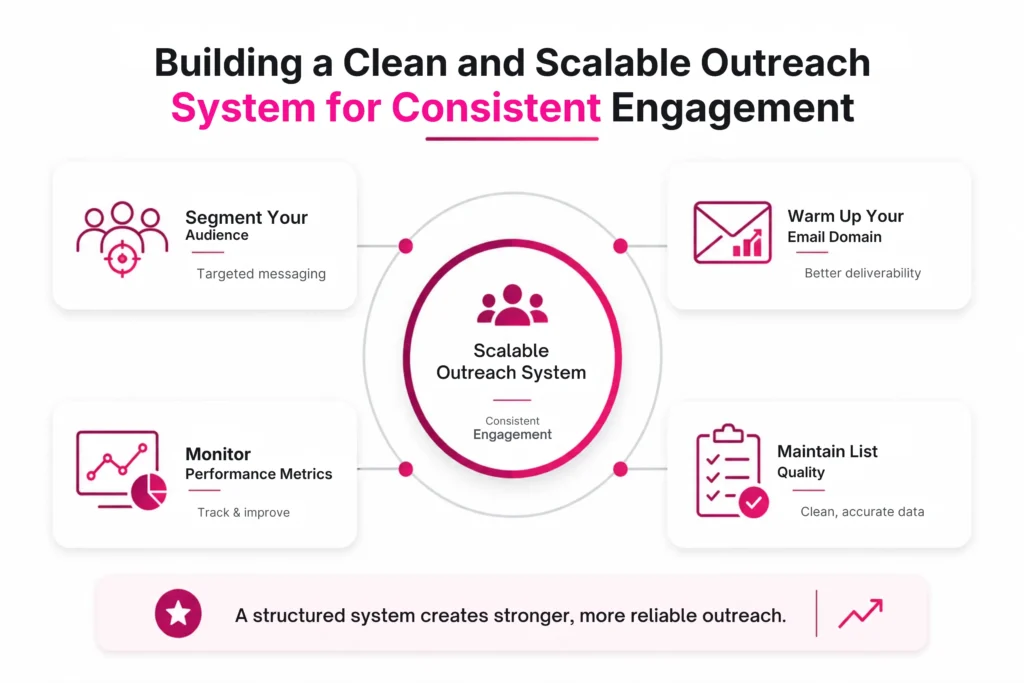
A structured system reduces risk and improves performance across campaigns. We follow such an approach to maintain consistency and achieve better outreach results:
Segment Your Audience
Segmentation based on industry, role, company size, or intent helps improve engagement and response rates. The approach reduces generic messaging and allows communication to align more closely with real needs, leading to stronger campaign performance.
Warm Up Your Email Domain
We gradually increase email volume when starting campaigns to build trust with email providers and avoid sudden spikes that can trigger filters. A proper warm up process improves sender reputation over time and supports better inbox placement. The step is essential for maintaining deliverability and ensuring outreach efforts produce consistent and reliable results.
Monitor Performance Metrics
You need to track performance metrics closely to understand how campaigns are performing and where improvements are needed. Monitoring open rates, reply rates, and bounce rates provides clear insight into engagement levels. Data driven adjustments help refine messaging, targeting, and timing, leading to more effective outreach and better overall campaign outcomes.
Maintain List Quality
Also, maintain clean and accurate contact lists to ensure messages reach real and relevant prospects instead of invalid or outdated addresses. Regular list cleaning reduces bounce rates and improves deliverability. High quality data also supports better targeting, increasing engagement and helping campaigns perform more consistently across different audience segments.
Can a Cold Email Outreach Service Company Help
Many companies struggle to manage email outreach effectively, especially without dedicated resources or experience, and we often see internal teams face inconsistency due to lack of structure. Outreach requires ongoing testing, refined targeting, and strong messaging to deliver results. Without a clear system, campaigns lose direction and fail to generate meaningful engagement.
Expertise and experience make a difference, and we bring tested strategies that have worked across industries. We use advanced tools and data to identify the right prospects more accurately. Messaging improves as we focus on communication that feels natural and relevant. This helps increase engagement and response rates.
Time savings is another advantage, as we handle B2B cold email outreach while internal teams focus on core priorities. We also build scalable systems that support growth without reducing quality. In our professional experience, we see that companies working with specialists achieve more consistent and measurable results.
Creating Long Term Relationships Through Outreach
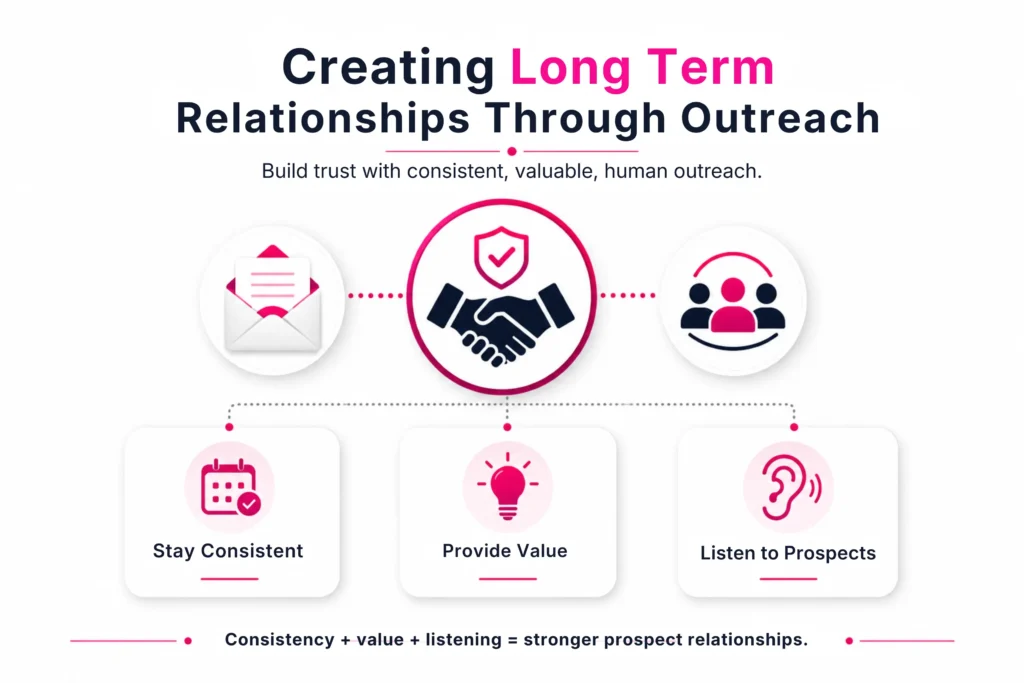
Outreach should not only focus on immediate results, as long term relationships create lasting value. We suggest taking a consistent approach that builds trust and keeps prospects engaged:
Stay Consistent
Maintaining a steady communication rhythm helps build familiarity and trust over time with prospects. When outreach happens at irregular intervals, engagement tends to drop because prospects lose track of the connection. A consistent presence keeps messages familiar without becoming overwhelming, which supports stronger long term relationships and improves response rates as recognition increases gradually.
Provide Value Beyond Sales
Sharing useful insights keeps prospects engaged even when they are not ready to buy, which makes outreach feel more helpful and less transactional. Educational content, industry updates, or practical tips can maintain interest without pressure. This approach builds credibility and encourages prospects to stay connected until the timing feels right for a decision.
Listen to Prospects
Paying attention to responses helps refine messaging and improve future interactions in a meaningful way. Every reply, question, or objection reveals what matters most to the prospect. Adjusting communication based on this feedback leads to more relevant outreach, stronger engagement, and better alignment with real needs over time.
Final Thoughts
Engaging prospects without spamming requires a thoughtful approach that prioritizes relevance, clarity, and consistency. In our professional experience, companies focusing on these elements consistently outperform those relying on volume driven tactics.
Each message represents an opportunity to start a meaningful conversation. When outreach is handled with care and precision, it leads to stronger relationships, better engagement, and sustainable growth.
Frequently Asked Questions
What is the best time to send cold emails for engagement?
Midweek mornings usually perform best since prospects are active, less busy, and more likely to notice and respond to outreach emails quickly.
How important is email list quality in outreach performance?
High quality lists improve deliverability and replies because accurate targeting ensures messages reach real decision-makers who are relevant and responsive.
Should cold emails always include links or attachments?
Cold emails perform better without links or attachments initially, since simple text improves trust, readability, and increases chances of receiving replies.