B2B cold email is generally legal when messages target professional contacts and comply with specific regulations. Most email laws treat business addresses differently from personal accounts, recognizing that corporate communication carries lower privacy risks.
Compliance depends on transparency, clear sender identification, and providing recipients a simple way to stop future messages. Even without prior consent, following these rules helps protect your company from fines, complaints, and reputational damage.
Read on to find how to send B2B cold emails safely, stay compliant, and maximize response rates.
What Counts as “Permission” in B2B Email Outreach?
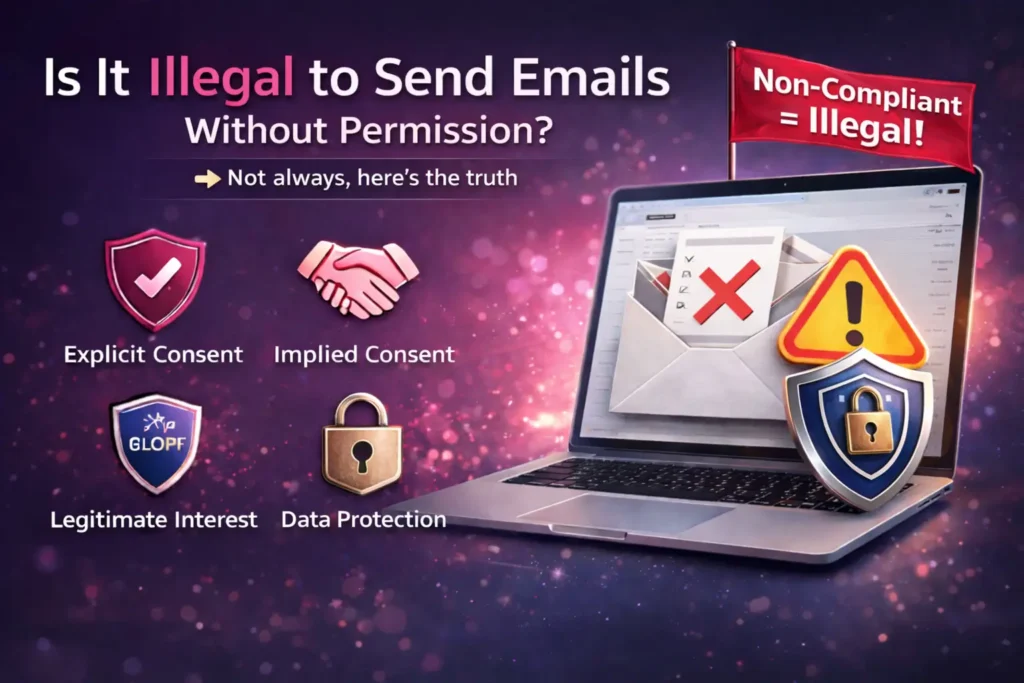
Permission in B2B email outreach can take several forms, and each carries a different level of legal strength. Explicit consent occurs when a person clearly agrees to receive your emails, such as ticking a box on a signup form or subscribing through a company website.
Implied consent arises through an existing business interaction. For example, a contact may share their email during a sales call, networking event, or inquiry about your services, which can justify a relevant follow up.
Within the European Union, GDPR allows outreach based on legitimate interest in certain cases. Your message must connect directly to the recipient’s professional duties and must not override their privacy rights.
Publicly listed corporate emails on official websites may support B2B communication. Role based addresses like info@ or sales@ generally pose fewer personal data concerns.
In many jurisdictions, prior approval is not mandatory for business to business emails, provided you identify yourself clearly and offer an easy “unsubscribe” method.
Email Laws by Country: What B2B Companies Must Know
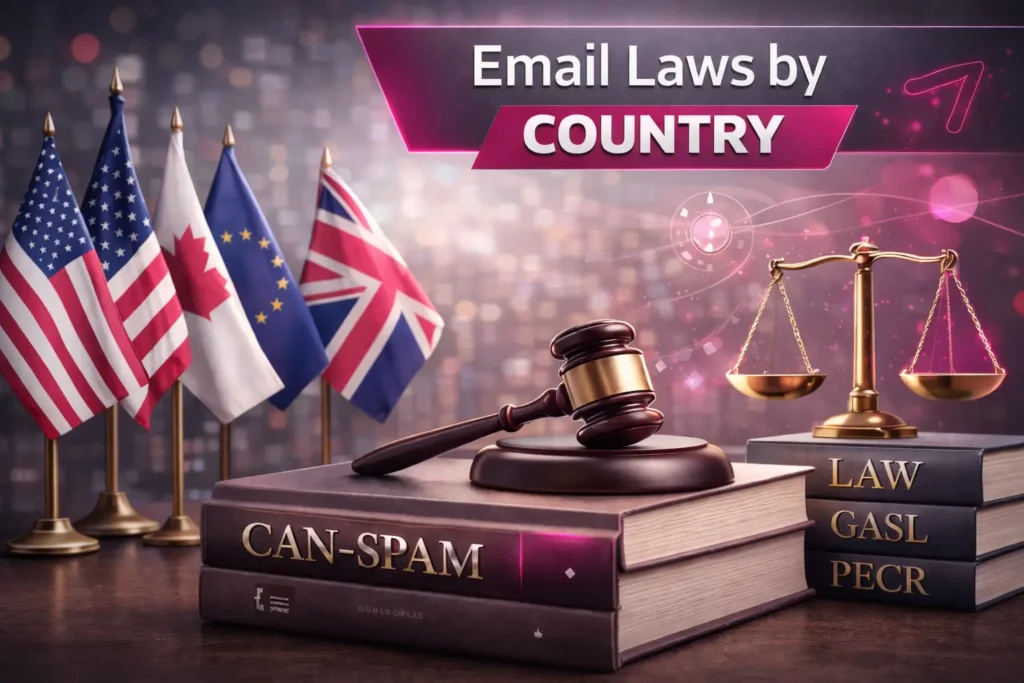
Email compliance depends on the recipient’s location, not yours, when conducting cold email outreach campaigns. B2B teams must check local laws before launching outreach campaigns across borders.
United States – CAN-SPAM Act
The CAN-SPAM Act governs commercial email in the United States. Prior consent is not required for B2B cold email, which makes outreach legally possible when done correctly.
Instead of demanding permission, the law focuses on honesty and transparency. It sets clear standards that every commercial message must meet:
- Accurate header and sender details
- No deceptive subject lines
- Clear identification as an advertisement
- Valid physical postal address
- Simple unsubscribe mechanism
You must process unsubscribe requests within ten business days. In addition, you cannot sell or transfer email addresses of those who unsubscribe.
B2B cold email remains legal under this framework and can be used to schedule a B2B appointment with prospects. However, each violation can result in significant financial penalties enforced by the Federal Trade Commission.
Companies targeting US prospects should create compliant templates, maintain updated suppression lists, and monitor unsubscribe handling carefully to reduce legal exposure.
European Union – GDPR
The General Data Protection Regulation applies across the European Union and protects personal data, including business email addresses linked to individuals. B2B cold email may be allowed, yet strict legal reasoning must support it.
Many organizations rely on legitimate interest as their lawful basis. You must demonstrate that your outreach serves a genuine commercial purpose and does not override the recipient’s rights.
Important GDPR requirements include:
- Clear identification of your company
- Disclosure of data source
- Explanation of processing purpose
- Easy unsubscribe option
- Data minimization practices
Consent may be required in certain member states due to local ePrivacy rules. National variations can increase compliance complexity.
Outreach agencies face higher risk if they purchase contact databases without verifying lawful data collection. Regulators expect documented assessments and internal review processes.
Companies targeting EU professionals should record their legal basis, limit stored data, and include transparent privacy notices in every campaign.
United Kingdom – PECR
In the United Kingdom, PECR works alongside UK GDPR and regulates electronic marketing communications. It sets specific standards for email outreach beyond general data protection principles.
Corporate addresses often allow marketing without prior consent, while sole traders and partnerships may require stricter compliance.
PECR obligations for B2B email include:
- Clear sender identification
- Accurate contact details
- Simple unsubscribe process
- Respect for unsubscribe requests
You must not conceal your identity or mislead recipients about the nature of the message. Each email must provide a direct method to stop future contact.
The Information Commissioner’s Office enforces PECR and has issued substantial fines for non compliant marketing practices.
Organizations targeting UK prospects should verify business classifications, maintain suppression records, and audit email practices regularly to reduce enforcement risk.
Canada – CASL
Canada’s Anti Spam Legislation, known as CASL, creates one of the strictest environments for commercial email. B2B cold email faces significant limits under this framework.
CASL generally requires consent before sending commercial electronic messages. Two forms of consent exist:
- Express consent through clear agreement
- Implied consent through existing business relationship
Implied consent may apply after a recent transaction, contract, or inquiry within a defined time frame. Outside those situations, cold outreach often violates the law.
Every compliant message must also include:
- Sender identification
- Mailing address
- Functional unsubscribe mechanism
Canada presents high financial risk because penalties can reach millions of dollars per violation. Enforcement authorities actively investigate complaints.
B2B teams should conduct strict risk assessments before targeting Canadian contacts. Companies without documented consent or recent relationships should avoid cold email campaigns in this market.
When Does B2B Cold Email Become Illegal?
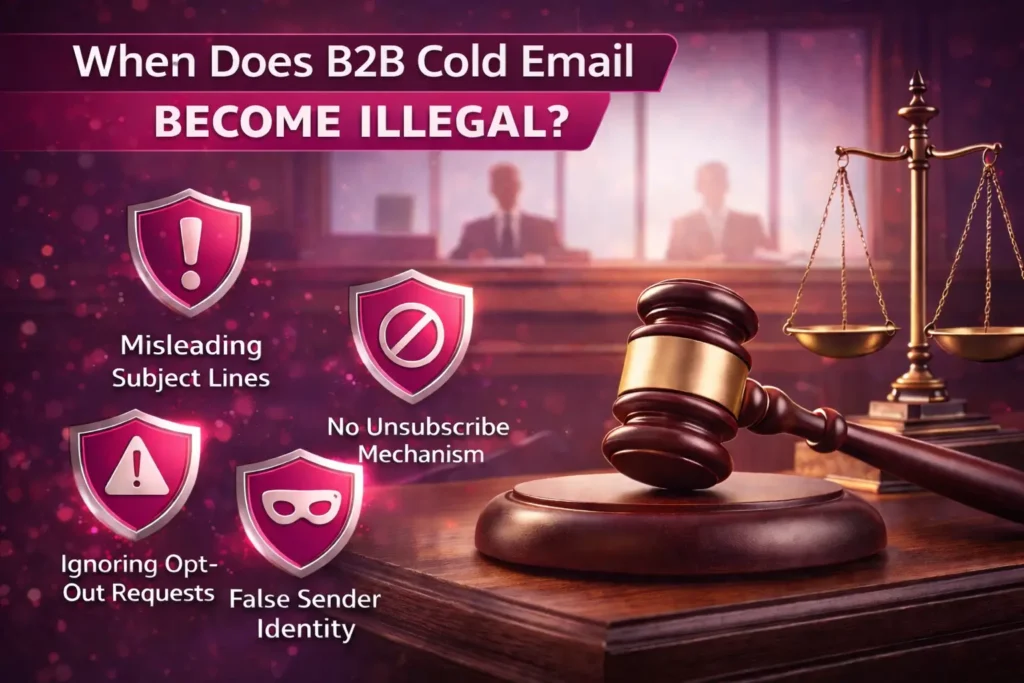
B2B cold email crosses legal lines when marketers ignore compliance rules and basic transparency standards while sending cold emails:
1. Misleading Subject Lines
Subject lines must reflect the actual content of the email. You cannot trick recipients into opening a message through false urgency, fake replies, or deceptive claims. Regulators treat misleading headings as consumer harm. Even in B2B outreach, inaccurate framing can trigger penalties and damage brand credibility.
2. No Unsubscribe Mechanism
Commercial emails must provide a clear and functional way for recipients to stop future messages. A hidden link or broken process creates compliance risk. Laws in several countries require a simple method to withdraw from mailing lists. Failure to include this feature can make an otherwise legal campaign unlawful.
3. Ignoring Opt-Out Requests
Once someone asks to stop receiving emails, you must act within the legally required time frame. Continuing outreach after a removal request shows deliberate non compliance. Authorities often view repeated contact as aggravated conduct. Maintaining accurate suppression records helps prevent accidental violations and protects your company.
4. False Sender Identity
Every outreach email must clearly identify the person or company behind the message. Using fake names, fabricated companies, or masked domains violates advertising and data laws. Transparency builds trust and reduces complaints. Concealing identity, on the other hand, increases regulatory scrutiny and financial exposure.
5. Scraping Personal Data Unlawfully
Collecting email addresses through unauthorized scraping tools can break data protection laws. Public visibility does not grant unlimited use rights. Regulators expect lawful data collection and documented legal basis. Outreach campaigns built on unlawfully gathered data expose companies and agencies to serious penalties.
6. Emailing Personal Accounts
Sending cold B2B offers to personal accounts such as Gmail or Yahoo raises additional legal concerns. Many laws draw stricter lines around individual consumers than corporate contacts. Even if the person holds a business role, using a private inbox can increase enforcement risk and complaint rates.
Cold Email vs Spam in a B2B Context
Cold email and spam are not the same in a B2B setting. The difference lies in targeting, relevance, legal compliance, and intent. Below is a clear comparison:
| Factor | B2B Cold Email | Spam |
| Targeting | Selected prospects based on role or industry | Large random lists with no filtering |
| Message Content | Relevant to recipient’s business duties | Generic and unrelated content |
| Personalization | Role specific details and context | No meaningful personalization |
| Legal Basis | Built on lawful data use and transparency | Often ignores legal requirements |
| Unsubscribe Option | Clear and functional removal method | Missing or hidden removal process |
| Sender Identity | Accurate company and contact details | Fake or misleading identity |
| Intent | Professional outreach for business value | Volume driven distribution with no qualification |
| Deliverability | Focus on list quality and engagement | High complaint and bounce rates |
| Compliance Risk | Managed through documented processes | High risk of penalties and enforcement |
How to Send Legal B2B Cold Emails (Compliance Checklist)
Follow these practical compliance steps to reduce legal exposure and protect your outreach strategy:
- Use verified business email addresses collected through lawful and transparent sources.
- Clearly identify yourself and your company with accurate contact details in every message.
- Write subject lines that reflect the real purpose of the email without exaggeration or deception.
- Include your valid physical business address to meet statutory disclosure requirements.
- Add a visible one click unsubscribe link that works without extra steps.
- Maintain updated suppression lists and permanently remove contacts who request removal.
- Follow verification and compliance practices to prevent your messages from being caught by an email spam filter.
- Document your legal basis for processing contact data and store records of data sources.
- Monitor removal requests consistently and process them within the required legal timeframe.
- Avoid sending campaigns to personal email accounts when targeting business contacts.
- Review the recipient’s country laws before launching outreach to ensure jurisdiction specific compliance.
What Happens If You Violate B2B Email Laws?
Non compliant B2B email practices can trigger serious operational, financial, and reputational consequences for your business:
i) Financial penalties: Regulators can impose substantial fines per violation, which may multiply across large email campaigns.
ii) Domain blacklisting: Spam complaints and abuse reports can place your sending domain on global blacklist databases.
iii) Email provider suspension: Email service providers may suspend or terminate accounts that breach anti spam policies.
iv) CRM or automation platform bans: Marketing automation and CRM tools can restrict access after repeated compliance violations or complaint spikes.
v) Reputation damage: Clients and prospects may lose trust if your brand appears associated with unlawful email practices.
vi) Long-term lead generation impact: Deliverability issues and damaged sender reputation can reduce response rates for months or years.
How Professional B2B Cold Email Outreach Agencies Stay Compliant
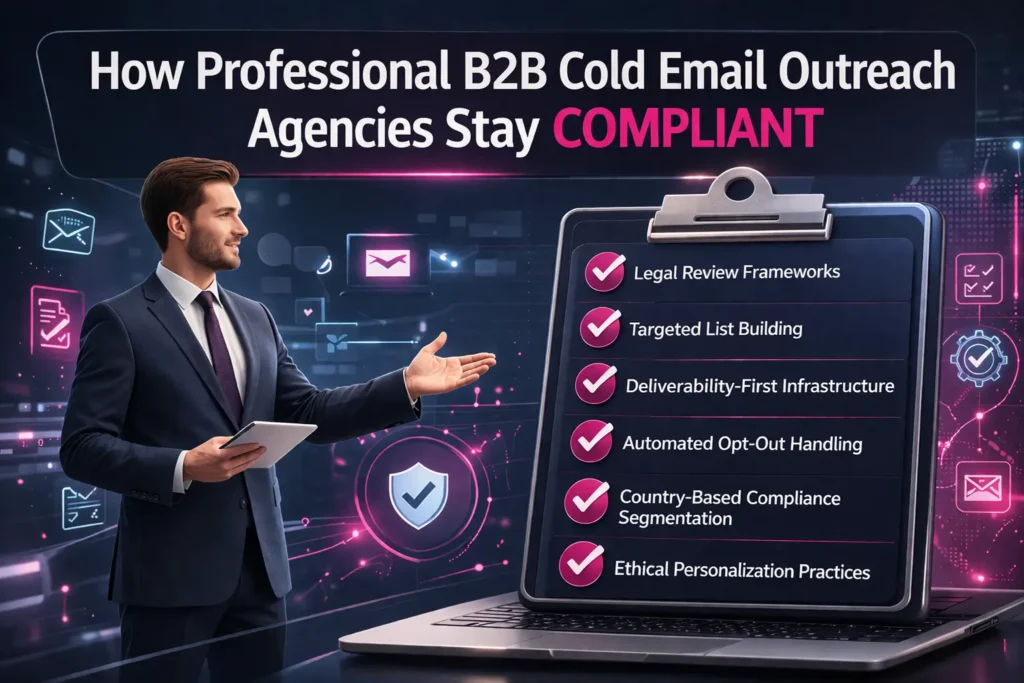
Top agencies like ProspectOut implement structured processes and tools to ensure outreach campaigns follow all relevant laws and maintain professional credibility:
1. Legal Review Frameworks
Agencies establish internal legal review systems to check campaigns before sending. Every message is evaluated for compliance with local, national, and international email regulations. Policies cover consent, disclosure, and content accuracy. Legal review frameworks reduce the risk of fines and regulatory complaints, ensuring campaigns remain fully lawful while preserving brand integrity and professional reputation.
2. Targeted List Building
Professional agencies build precise contact lists using B2B prospect list building techniques based on verified business data and relevant roles. They avoid purchased or scraped personal information. Lists are regularly updated and cleaned to remove inactive or non compliant contacts. Targeted list building improves engagement rates and minimizes legal exposure while ensuring messages reach decision makers who genuinely benefit from the outreach.
3. Deliverability-First Infrastructure
A reliable sending infrastructure is critical for compliance and ensures the email deliverability benefits of your campaigns are maximized. Agencies use authenticated domains, monitored IP addresses, and email reputation management tools. This approach ensures messages reach inboxes rather than spam folders. Deliverability-first infrastructure reduces bounce rates, supports lawful campaigns, and prevents accidental violations that might occur if emails are flagged as spam or returned repeatedly.
4. Automated Opt-Out Handling
Automation tools are implemented to process unsubscribe or removal requests instantly. Agencies track opt-out lists and ensure no further contact with these addresses. Automated handling minimizes human error, ensures compliance with legal timeframes, and strengthens recipient trust. Efficient opt-out management protects campaigns from complaints and reduces potential penalties for ignoring removal requests.
5. Country-Based Compliance Segmentation
Agencies segment contact lists based on the recipient country to comply with local regulations like CAN-SPAM, GDPR, PECR, or CASL. Each segment has tailored processes reflecting jurisdictional differences, including consent requirements and disclosure rules. Country-based compliance segmentation ensures outreach campaigns adhere to regional laws while maintaining efficiency and minimizing the risk of cross-border violations.
6. Ethical Personalization Practices
Messages are personalized using professional information relevant to the recipient’s role and business context. Agencies avoid sensitive personal data or irrelevant private information. Ethical personalization improves engagement, demonstrates professionalism, and aligns with data protection laws. This practice balances effective marketing with lawful behavior, reducing complaint rates and protecting both the agency and client from legal exposure.
Is B2B Cold Email Still Safe and Effective?
Compliant B2B cold email remains a powerful tool in the present year because it reaches decision makers directly with relevant offers. Businesses that follow legal guidelines, verify contact data, and personalize messages see higher engagement rates. Proper targeting ensures campaigns connect with prospects who are likely to respond, making outreach efficient and measurable.
The risks of non compliant email, including fines, blacklisting, and reputational harm, are significant, but controlled campaigns reduce exposure. Companies should balance effort and reward by using verified lists, clear identification, and transparent removal processes. Strategic cold email, integrated with other marketing channels, continues to provide cost effective lead generation and strengthens long-term business relationships.
Final Thoughts
B2B cold email remains a legal and effective marketing strategy in many regions when executed correctly. Its success depends on following rules, targeting relevant business contacts, and ensuring transparency in all communications. Proper compliance not only reduces risk but also enhances engagement and builds trust with prospects.
The legality of cold outreach varies by country, so understanding local laws is essential. Companies must verify data sources, provide clear identification, and respect removal requests. When these practices are followed, cold email campaigns can safely generate leads and nurture relationships. Start reviewing your outreach processes today to ensure full compliance and maximize results.
Frequently Asked Questions
Are role-based emails like sales@ or info@ fully exempt from consent?
These addresses are generally lower risk, but compliance still requires transparency, clear identification, and functional unsubscribe options.
Can I include attachments or promotional PDFs in cold emails?
Attachments increase risk of spam filtering and regulatory scrutiny. It’s safer to link to hosted content instead of sending files directly.
Is it legal to use third-party email lists for B2B outreach?
Third-party lists can be risky. You must verify that the contacts were collected lawfully and that their use aligns with local data protection regulations.