Imagine sending 500 cold emails and receiving little interest in your SaaS product. The problem may not be your solution but how you approach potential customers. I noticed for years that effective outreach starts with understanding buyer needs, identifying relevant decision-makers, and delivering personalized messages.
The solution is to build a structured outreach strategy that connects the right prospects with the right message at the right time.
From defining your ideal customer profile to optimizing your campaigns, here I share seven practical ways to get more demo bookings for your B2B SaaS business.
1. Identify Your Ideal Customer Profile (ICP)
Before launching any outreach campaign, my priority is to identify who is most likely to benefit from your SaaS product. Without a clearly defined ideal customer profile (ICP), your sales team may waste time contacting businesses that lack interest, budget, or decision-making authority to purchase your solution.
An ICP describes the type of company that is most likely to become a successful customer. Depending on your product, relevant characteristics may include industry, company size, annual revenue, location, technology stack, and business model.
If your SaaS platform helps sales teams automate prospecting, your ideal customers might be B2B companies with dedicated sales teams, an established outbound strategy, and a need to improve prospecting efficiency.
Once you define the company profile, identify the people within those organizations who influence purchasing decisions. These might include sales directors, heads of growth, revenue operations managers, or business development leaders.
Next, research their specific challenges. Consider what slows down their workflows, increases operating costs, or prevents them from achieving their goals. Your product’s value proposition should directly address these problems.
So, how to improve your ICP? I suggest you to:
- Analyze your existing customers to identify common characteristics among your most successful accounts.
- Review customer feedback, sales conversations, and support requests to understand recurring pain points.
- Identify industries and company sizes where your product delivers the clearest value.
- Refine your ICP as you gather more information from outreach and sales conversations.
2. Build a Targeted Contact List
Once you know which companies and decision-makers to target, the next step is building a high-quality contact list.
A large prospect list may look impressive, but volume alone does not generate demo bookings. Contacting hundreds of poorly matched prospects can waste sales resources, damage sender reputation, and produce few meaningful conversations.
Instead, focus on identifying people who are likely to need your solution and have a reason to consider it now.
You can use prospecting tools such as Apollo and LinkedIn Sales Navigator to find companies and decision-makers that match your ICP.
Apollo can help you discover business contacts and access available contact information. LinkedIn Sales Navigator is useful for researching professional profiles, identifying relevant roles, and finding companies that meet your targeting criteria.
When building your list, collect relevant information such as:
- Full name and professional email address
- Job title and department
- Company name, industry, and size
- Company website and LinkedIn profile
- Relevant business challenges or potential buying signals
Buying signals can help you prioritize prospects. For instance, a company hiring several sales representatives may be expanding its sales operations and could benefit from sales enablement or prospecting software.
However, a buying signal is an indication of potential relevance, not proof that a company is ready to purchase.
Organize your contacts into segments based on industry, job role, company size, or business challenge.
Remember that contact information should be collected and used responsibly. Our B2B prospect list building service can be a practice choice if you struggle with it.
3. Verify Your Contact List Before Outreach
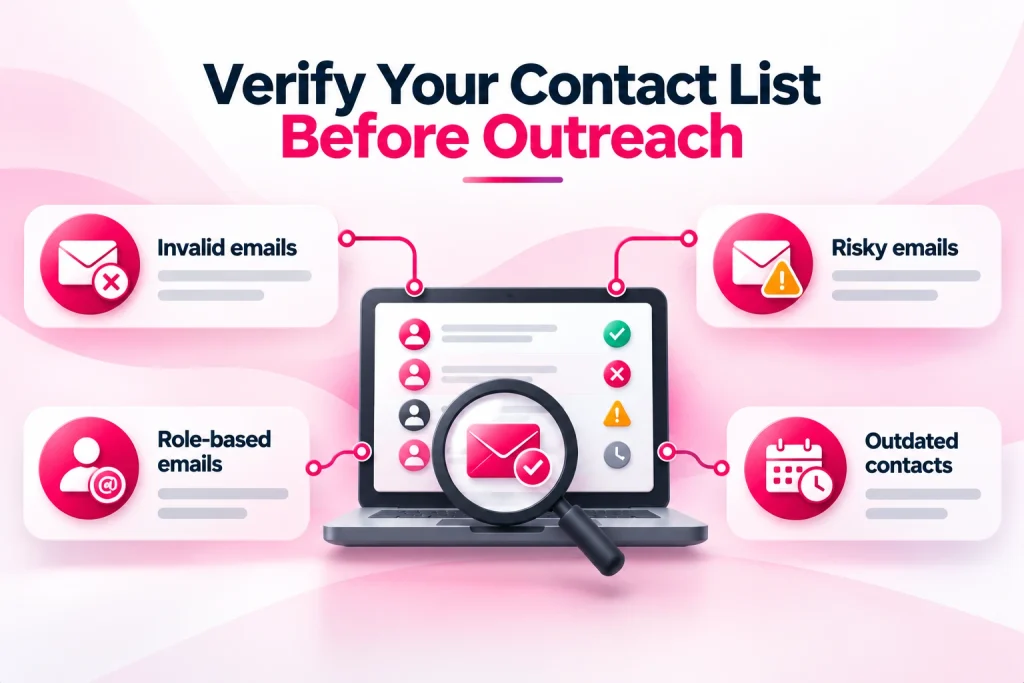
Sending messages to invalid addresses increases bounce rates and can negatively affect your email sender reputation. If deliverability deteriorates, more of your messages may fail to reach prospects’ inboxes, limiting the effectiveness of your outreach.
Email verification helps identify potentially invalid addresses before you launch a campaign.
I use email verification tools such as NeverBounce, ZeroBounce, and MillionVerifier to check contact lists and identify invalid, risky, or undeliverable email addresses. Depending on the service, verification may involve syntax checks, domain and mail server checks, and other signals to assess email deliverability.
Pay particular attention to these categories:
- Invalid emails: Addresses identified as undeliverable should generally be removed.
- Risky emails: Addresses with uncertain deliverability should be handled cautiously.
- Role-based emails: Addresses such as info@ or sales@ may reach shared inboxes rather than individual decision-makers.
- Outdated contacts: People who have changed roles or companies may no longer be relevant to your campaign.
For better results, verify contacts close to the time of outreach, remove hard bounces promptly, and monitor bounce rates throughout your campaigns. Combine verification with appropriate sending practices, accurate targeting, and relevant messaging.
4. Personalize Your Cold Emails
Personalization is one of the most important elements of effective B2B cold email outreach. I always consider each prospect’s responsibilities, pain points, and business goals when crafting emails to communicate relevant value and encourage meaningful responses.
However, personalization goes beyond inserting someone’s first name or company name into a template. Effective personalization demonstrates that you understand why your solution might matter to that particular prospect.
Start with a relevant observation about the prospect or their company. This could be a recent product launch, a hiring trend, a new market expansion, or a challenge commonly associated with their role.
Then connect that observation to a problem your SaaS product can help solve.
If your platform automates sales prospecting, you might explain how it helps sales teams reduce manual research and spend more time engaging qualified prospects. Keep the message focused on the prospect’s potential benefit rather than listing every product feature.
A simple cold email structure includes:
- Subject line: Make it relevant, concise, and natural.
- Opening line: Establish a genuine connection to the prospect’s role or business.
- Problem statement: Highlight a challenge they may recognize.
- Value proposition: Explain how your product can help address that challenge.
- Call to action: Ask a clear, low-friction question about a demo or conversation.
Avoid exaggerated claims, generic praise, and lengthy product descriptions. Every sentence should help the prospect understand why the conversation may be worthwhile. Most importantly, make sure your claims are accurate and your proposed benefits are relevant to the recipient.
5. Leverage LinkedIn Outreach Alongside Email
Cold email can be effective, but relying on a single channel may limit your opportunities to connect with decision-makers. LinkedIn offers another way to introduce your business, engage relevant professionals, and support your outreach efforts.
Start by researching prospects on LinkedIn. Review their roles, company updates, professional interests, and recent activity to identify relevant conversation starters.
You can then send a personalized connection request that briefly explains the professional reason for connecting.
For example, a prospect who recently shared a post about sales team productivity might be interested in a practical insight about reducing manual prospecting work. This creates a more natural opening for a conversation about your SaaS solution.
To coordinate your channels, consider a sequence such as:
- Send a relevant cold email.
- Review the prospect’s LinkedIn profile and send a personalized connection request.
- Follow up by email with additional context or a useful insight.
- Send a LinkedIn message if the connection has been accepted and the conversation is appropriate.
- Invite the prospect to a demo when there is a clear reason to explore the product.
The sequence should reflect the prospect’s engagement and preferences. The goal is not simply to increase the number of messages sent. It is to create more relevant opportunities for prospects to understand your product and consider a demo.
6. Follow Up Consistently
Many prospects will not respond to your first cold email. They may be busy, focused on other priorities, or simply unable to evaluate a new solution at that moment.
A lack of response does not necessarily mean a lack of interest. That is why a thoughtful follow-up strategy is essential for increasing demo bookings.
Consistent follow-up does not mean sending the same message repeatedly. Each follow-up should provide a reason for the prospect to reconsider your offer.
Your first message might introduce the problem your product solves. The next could explain a specific benefit, while a later message might share a relevant use case or ask whether the prospect is the right person to contact.
A practical starting point is a short sequence of three to five touches over approximately two weeks, adjusted for your audience, industry, and engagement patterns.
You can also use LinkedIn to support the sequence and consider a phone call when it is appropriate for your audience and outreach approach.
7. Test and Optimize Your Campaigns
Generating more demo bookings requires continuous improvement. Even a well-researched list and a carefully written email may not perform as expected with every audience.
Rather than relying on assumptions, use campaign data to identify what works and where prospects lose interest.
Start by tracking metrics that reflect different stages of your outreach process.
Important metrics to monitor include:
- Bounce rate: Shows how many emails could not be delivered.
- Positive reply rate: Measures how often outreach generates genuine interest.
- Demo booking rate: Tracks the percentage of targeted prospects who book a demo.
- Show-up rate: Measures how many booked prospects attend their scheduled demos.
- Conversion rate: Tracks how effectively demos progress into qualified opportunities or paying customers.
Email open rates may offer limited directional insight, but privacy features and automated image loading can make them unreliable. Prioritize meaningful replies, qualified meetings, and downstream sales outcomes.
Next, test one variable at a time whenever practical. Experiment with subject lines, opening messages, value propositions, calls to action, audience segments, and follow-up timing.
Finally, connect your findings to your ICP and messaging strategy. If one industry consistently produces more qualified demo bookings, refine your targeting around the characteristics that make those prospects a good fit. Optimization should be an ongoing process, not a one-time exercise.
Final Opinion
I observed for years that successful B2B SaaS outreach depends on precise targeting, verified contact data, personalized messaging, consistent follow-ups, and continuous testing. Focusing on qualified prospects rather than outreach volume helps businesses generate meaningful conversations and improve demo booking opportunities.
ProspectOut helps businesses strengthen their cold outreach strategies. Let’s discuss practical ways to improve demo bookings for your B2B SaaS business through better targeting, accurate prospect data, and personalized email campaigns that drive meaningful engagement.