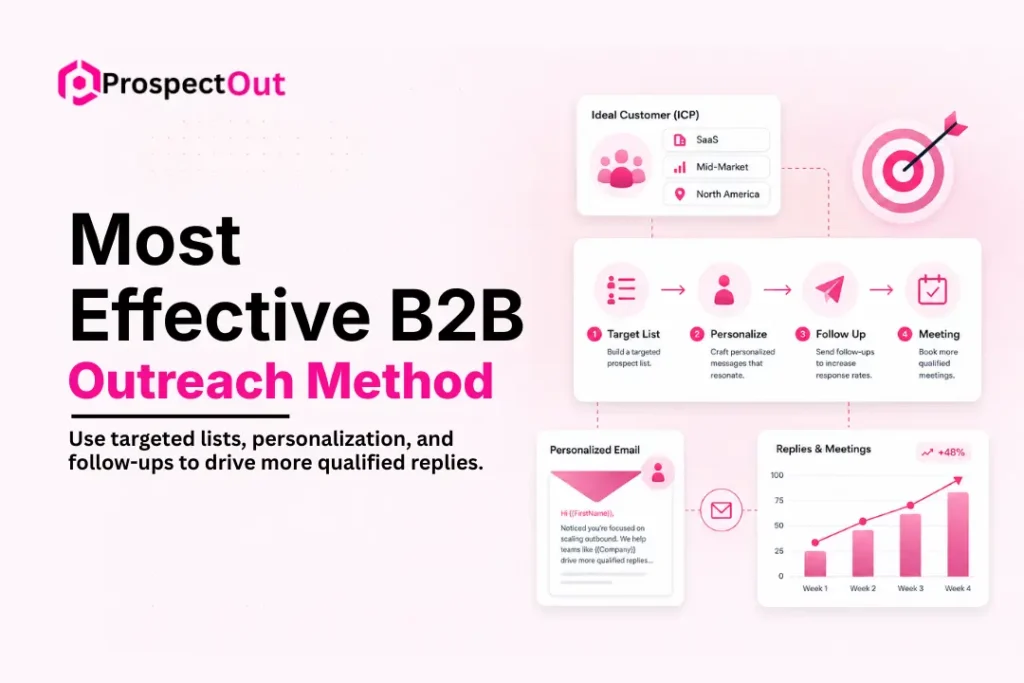
From most angles, cold email outreach is the most effective B2B outreach method. It scales fast, costs little, and puts your message directly in front of decision-makers. However, the right method for your business still depends on your goals, deal size, and team capacity.
Read the rest to find out which approach fits your goals and how to get the most out of it.
The Most Common B2B Outreach Methods
B2B teams use many outreach tactics, but these five channels dominate the landscape and produce the most measurable results:
- B2B Cold Email Outreach
- LinkedIn Networking
- Cold Calling
- Content Marketing Outreach
- Event and Conference Networking
| Method | Cost | Scale | Speed | Best For | Avg. ROI |
| Cold Email | Low | Very High | Fast | Lead gen at scale | High |
| Low–Med | Medium | Moderate | Relationship building | Medium | |
| Cold Calling | Medium | Low | Fast | Follow-up & closing | Medium |
| Content Marketing | Medium | High | Slow | Trust & authority | High (long-term) |
| Event Networking | High | Very Low | Slow | Enterprise deals | Very High (niche) |
1. Cold Email Outreach — The Highest-ROI Channel at Scale
HubSpot reports that email generates an average ROI of $36 for every $1 spent, making it the most cost-efficient active outreach channel in B2B. It works because your message lands directly in a decision-maker’s inbox with no gatekeeper in the way. Buyers in B2B are also conditioned to evaluate offers via email, which lowers resistance from the start.
Scalability is where cold email truly separates itself. One rep using tools like Instantly or Lemlist can run sequences to hundreds of prospects simultaneously, and costs do not rise proportionally as volume grows. A well-crafted sequence can book meetings within 48 to 72 hours of launch, faster than any relationship-dependent channel.
- Best Use Case: SaaS, agencies, and consultancies targeting mid-market buyers.
- Conversion Rate: 1%–5% per campaign; optimized sequences push reply rates past 15%.
- Cost Per Lead: $20–$50.
- Biggest Strength: Full automation at low cost with measurable results.
- Weakness: Deliverability suffers without consistent personalization.
- Short-term ROI: Booked calls can appear within days of launch.
- Long-term ROI: Compounds as sender reputation builds and sequences improve with data.
Also read: B2B cold email best practices
2. LinkedIn Networking — Best for Relationship Building
According to LinkedIn’s own marketing data, 80% of B2B leads generated through social media come from LinkedIn, and the platform now hosts over 900 million professionals. What makes it effective is context, when a prospect already sees you engaging with relevant content, your outreach feels warm rather than cold. That credibility shortens the path from first contact to booked call.
The structural limitation is volume. LinkedIn caps connection requests at roughly 100 per week, and one rep can realistically manage 30 to 50 active conversations without quality dropping. Expect a two-to-four-week window before conversations turn into qualified opportunities, which makes this channel better suited to long sales cycles than quick pipeline builds.
- Best Use Case: Enterprise deals and long sales cycles where trust matters most.
- InMail Open Rate: 57.5% on average, higher than standard email.
- Monthly Cost: ~$100 per seat via Sales Navigator.
- Biggest Strength: Professional credibility and durable relationship building.
- Weakness: Low volume ceiling and slow pipeline velocity.
- Short-term ROI: Slow, meaningful results take several weeks to materialize.
- Long-term ROI: High for enterprise accounts as relationships deepen over months.
3. Cold Calling — Still Relevant as a Follow-Up Tool
RAIN Group research found that 69% of buyers accepted a call from a new provider in the past year, which directly challenges the claim that phone outreach is obsolete. Cold calling works best not as a first touchpoint but as a follow-up layer on top of email or LinkedIn. A prospect who already received a message is far more likely to engage when a call comes through, and the combination of channels lifts connection rates considerably.
Scalability is the hard ceiling here. A skilled rep makes 50 to 80 calls per day with connection rates between 6% and 8%, producing roughly five to seven qualified conversations daily. The upside is speed: every call ends in an immediate outcome, making it the fastest feedback loop of any channel.
- Best Use Case: Following up on opened emails or warm LinkedIn connections.
- Conversion Rate: 2%–6% cold; jumps to 10%+ in warm follow-up contexts.
- Biggest Strength: Live objection handling and fast rapport building.
- Weakness: Rep burnout and a hard daily volume ceiling.
- Short-term ROI: Depends heavily on rep skill and talk track quality.
- Long-term ROI: Improves as reps refine messaging and target higher-value segments.
4. Content Marketing Outreach — Long Game, High Trust
Companies publishing consistent content generate 3x more leads than outbound-only teams. The reason is timing: buyers prefer to research solutions before speaking with a sales rep, and content positions your brand as the credible answer before the conversation even starts. That prior trust reduces friction significantly later in the sales process.
The trade-off is speed. Most content strategies take six to twelve months to gain meaningful organic traction, which makes this channel unsuitable as a short-term fix. However, a single strong blog post or case study can attract leads for years post-publication, and cost per lead drops sharply as domain authority builds over time.
- Best Use Case: SaaS, professional services, and manufacturers with long sales cycles.
- Lead Conversion Rate: 14% (+/—) prospects arrive informed and pre-qualified.
- Monthly Investment: $2,000–$10,000 for writers, strategists, and tools.
- Biggest Strength: Compounds in value over time with no additional spend per lead.
- Weakness: Slow start and requires sustained publishing commitment.
- Short-term ROI: Minimal in the first six months.
- Long-term ROI: Among the highest of any channel once organic traffic establishes consistent inbound flow.
5. Event and Conference Networking — High Quality, Low Scale
Harvard Business Review research found that in-person requests succeed 34 times more often than digital ones, a conversion premium no other channel comes close to matching. Events work because they compress weeks of email back-and-forth into a single conversation. Prospects form strong impressions fast, and the right room can open doors that no amount of digital outreach will unlock.
The ceiling, however, is real. A rep attends 10 to 20 events per year at most, and meaningful one-on-one conversations per event number in the dozens. Post-event follow-up within 24 hours is critical, connections that seem strong in person fade quickly without swift, personalized outreach to extend the conversation.
- Best Use Case: Closing enterprise deals and breaking into relationship-driven verticals.
- Conversion Rate: 10%–20% for qualified event leads — highest per-contact rate of any channel.
- Event Cost Range: $5,000–$50,000 per event including travel and booth fees.
- Biggest Strength: Deepest relationships and highest deal quality.
- Weakness: Very high cost and extreme volume limits.
- Short-term ROI: Variable — depends on event quality and follow-up execution speed.
- Long-term ROI: Extraordinary for enterprise and partnership deals when you attend the right events consistently.
Which B2B Outreach Method Is Right for Your Business?
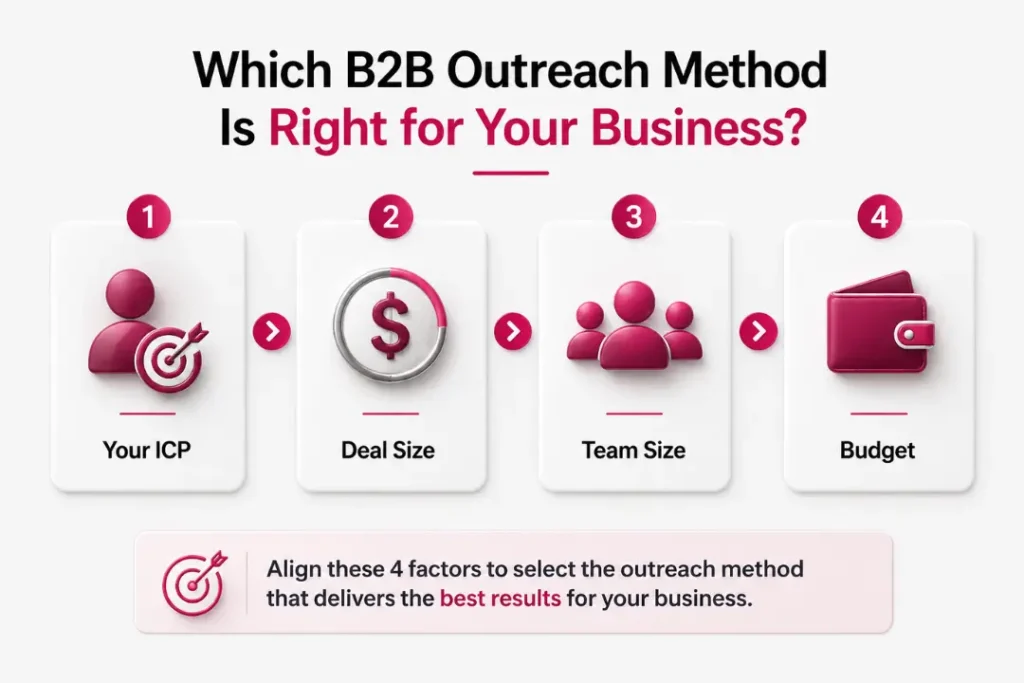
Not every outreach channel fits every business situation. The right choice depends on four factors that define how you should approach the market:
Your Ideal Customer Profile (ICP)
Your ICP determines which channels your target buyers actually use. If your buyers are VP-level decision-makers at enterprise firms, LinkedIn and events offer more direct access because those buyers are active there and respond to peer-level credibility.
If your ICP is founder-led SMBs or growing startups, cold email reaches them faster and more affordably. Match your channel to where your buyers spend time and what communication style they prefer, and your outreach will land far more effectively.
Deal Size
Smaller deal sizes demand channels that scale efficiently. Cold email works well when your average contract value sits below $10,000, because high volume compensates for lower conversion rates and keeps customer acquisition cost in check.
Larger deals, especially those above $50,000, justify the slower, higher-touch approaches like LinkedIn networking and event attendance. The relationship investment makes economic sense when the eventual contract value is significant enough to cover the longer sales cycle and higher cost per contact.
Team Size
Small teams of one to three sellers need channels that deliver results without heavy manual effort. Cold email automation tools let a lean team punch well above their weight.
Larger sales teams with dedicated SDRs can divide labor effectively across multiple channels, running cold email, LinkedIn outreach, and phone follow-up in parallel. Content marketing requires a separate content team or agency support, making it more viable as team size grows and dedicated resources become available to sustain a publishing schedule.
Budget
Budget shapes every strategic outreach decision. Cold email is the most accessible channel, with monthly tool costs often under $200. Content marketing demands higher upfront investment but yields compounding returns over time. Cold calling requires hiring and training reps, which adds fixed payroll costs.
LinkedIn Sales Navigator adds per-seat subscription costs. Event attendance carries the highest single-event expense. Match your channel mix to actual budget capacity rather than aspiration, and prioritize channels where your spend delivers measurable, trackable results.
Why Cold Email Outreach Is the Most Effective Method
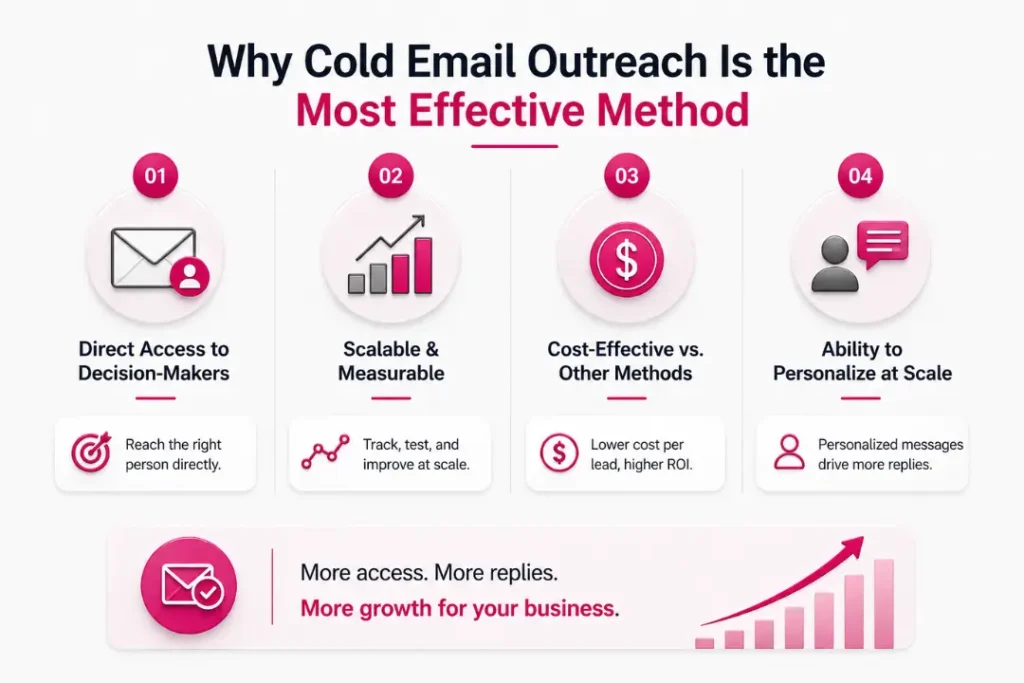
Among all the channels reviewed, cold email consistently outperforms on the metrics that matter most for B2B growth. Four specific advantages explain why it leads the pack:
Direct Access to Decision-Makers
Cold email puts your message directly in front of the person who holds purchasing authority. There are no gatekeepers filtering your outreach before it reaches a VP or C-suite contact. Tools like Apollo, Hunter, and ZoomInfo allow sales teams to identify verified business emails for specific job titles at target companies.
This precision means your message reaches the right person at the right company without relying on referrals, paid ads, or chance encounters. That level of direct access is difficult to replicate through any other outreach channel at similar cost.
Scalable and Measurable Campaigns
Cold email scales without proportional cost increases. A single rep using an automation platform can run sequences to 500 or more prospects simultaneously while tracking every open, click, and reply in real time. That data visibility allows rapid iteration: teams can test subject lines, adjust messaging, and cut underperforming sequences in days rather than months.
No other outreach channel offers this combination of volume, feedback speed, and measurement precision. The result is a system that improves with each campaign, compounding returns as data accumulates and patterns become clear.
Cost-Effective Compared to Other Methods
Cold email delivers the lowest cost per qualified lead of any active outreach channel. A typical cold email stack, including an email tool, data provider, and CRM integration, costs between $150 and $400 per month.
At a 3% reply rate across 1,000 emails, that translates to 30 replies and potentially five to eight booked B2B meetings for a fraction of what a single trade show booth would cost. For startups and growth-stage companies managing limited resources, this cost efficiency allows aggressive outreach without burning through budget before revenue grows enough to support heavier investment in other channels.
Ability to Personalize at Scale
Modern cold email tools allow dynamic personalization that goes far beyond inserting a first name. Teams can pull in a prospect’s job title, company name, recent funding round, tech stack, or news mention to craft messages that feel individually written even when sent at scale.
This level of personalization dramatically increases reply rates compared to generic blast emails. Research from Experian shows that personalized emails deliver 6x higher transaction rates than non-personalized ones. That advantage compounds when you apply it across hundreds of well-targeted prospects, making each dollar of outreach investment produce substantially stronger outcomes.
Final Thoughts
B2B outreach is never one-size-fits-all, but the evidence clearly points in one direction. Cold email wins on scale, cost, speed, and measurability. It wins for scale and ROI without question.
Many teams use cold email as the engine that drives consistent pipeline and layer in LinkedIn, calls, and events where budget and deal size justify the effort. ProspectOut runs B2B cold email outreach that fills your pipeline with qualified B2B leads, so your team can focus on closing.
Frequently Asked Questions
What is the best outreach strategy for B2B sales?
Cold email delivers the strongest results for most B2B teams due to its low cost, high scalability, and measurable performance across industries and deal sizes.
Is cold email still effective in 2026?
Yes. Cold email remains one of the highest-ROI outreach channels in 2026 when paired with strong personalization, verified data, and a well-structured follow-up sequence.
How many touchpoints does it take to convert a B2B prospect?
Most B2B conversions require six to eight touchpoints. Combining cold email, a LinkedIn message, and a follow-up call significantly increases your chances of getting a response.
How do you help with B2B cold email outreach?
We build qualified prospect lists, runs targeted B2B cold email outreach, and sets appointments so your sales team shows up only to confirmed meetings.