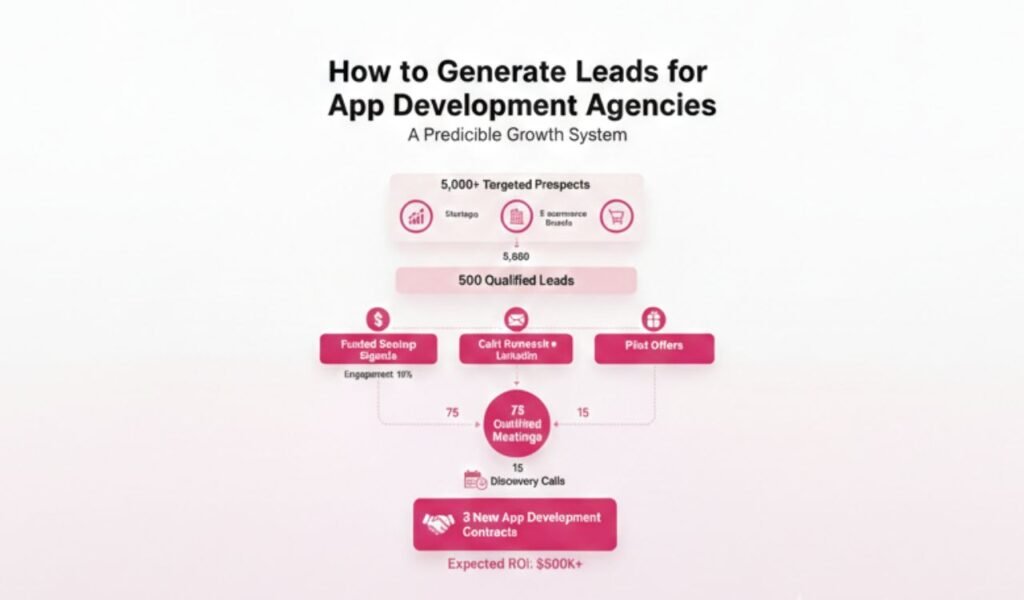
Crunchbase tracked $445 billion in global startup funding in 2024, yet most app development agencies never connect with funded companies desperate for their services.
Top-performing agencies systematically generate leads for app development agencies by targeting funded startups, enterprise teams expanding mobile, and e-commerce brands with poor app experiences.
The most effective ways to generate leads for app development agencies combine funded startup prospecting, cold outreach to decision-makers, LinkedIn engagement, and low-commitment pilot offers.
Agencies using these methods book 10-18 qualified meetings monthly versus 2-3 sporadic inquiries.
This breakdown shows which strategies work, who to target, and how to fill your pipeline predictably.
Why Most App Development Agencies Struggle With Consistent Lead Flow
Referrals feel comfortable until they stop coming. One client refers you in March, nothing happens until August.
That randomness prevents hiring senior developers or confidently turning down low-value projects.
RFP competitions turn development into commodity pricing wars.
You spend 12 hours on proposals for prospects comparing five agencies purely on cost. Close rates stay stuck at 8-12% because you’re talking to price shoppers, not qualified buyers.
Long sales cycles with zero pipeline visibility create another problem.
App development deals take 4-8 months from contact to contract. Without consistent opportunities entering monthly, one lost Q2 deal means scrambling in Q4 with no backup.
Who You Should Actually Target (Not Just “Anyone Needing an App”)
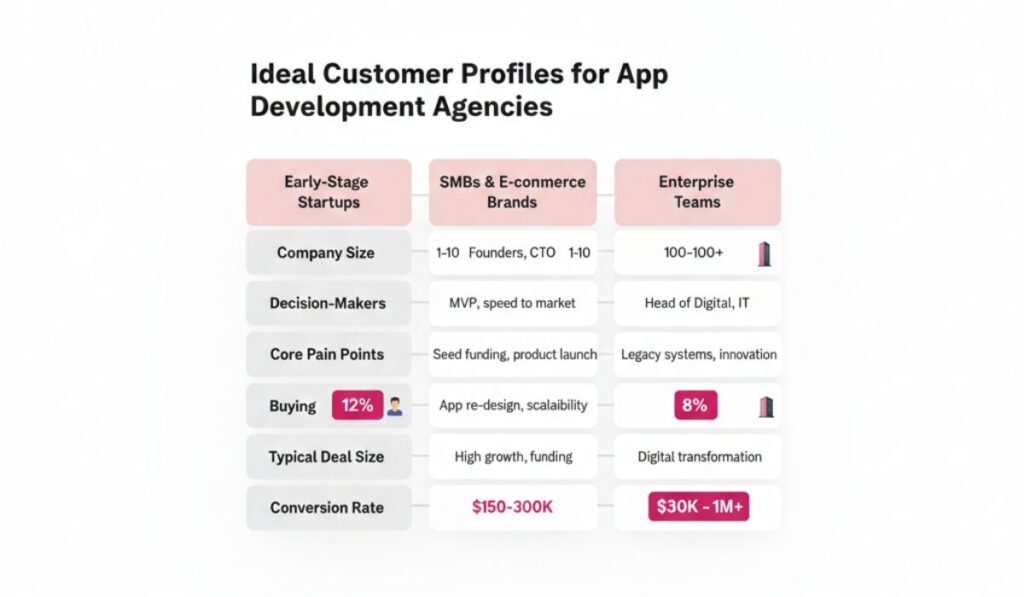
Blasting outreach to every company with “CTO” in their title wastes time and kills deliverability. Precision beats volume when you focus on these three high-converting profiles.
Early-Stage Startups Building MVPs
Company Profile: 1-20 employees, pre-seed through Series A funding, product-focused
Decision-Makers: Founders, CTOs, Heads of Product
Core Pain Point: Need an MVP shipped in 6-12 weeks, investors demanding progress, no in-house development team yet
Buying Signals to Track:
- Announced funding rounds (check Crunchbase daily)
- Joined accelerators like Y Combinator, Techstars, 500 Global
- Posted developer job openings they can’t fill fast enough
- Teased product launches on LinkedIn or Twitter
These startups convert at 18-25% because timing aligns perfectly. They have budget, urgency, and decision-makers who can say yes in one meeting.
SMBs & E-commerce Brands Expanding Mobile
Company Profile: 20-500 employees, established revenue, existing web presence
Decision-Makers: Head of Operations, Growth Managers, COOs, Marketing Directors
Core Pain Point: Losing customers to competitors with better mobile experiences, seasonal revenue opportunities requiring apps, inventory systems needing mobile access
Buying Signals:
- Launched new product lines needing mobile commerce
- Competitors released apps stealing market share
- Job postings for mobile product managers
- Mentioned “mobile strategy” in earnings calls or press releases
E-commerce brands convert slower (12-18%) but deliver higher lifetime value through ongoing feature development and maintenance contracts.
Enterprises Needing Team Augmentation
Company Profile: 500+ employees or large divisions within enterprises
Decision-Makers: VP Engineering, Director of Product, Program Managers, IT Directors
Core Pain Point: Internal dev teams maxed out, tight deadlines on strategic initiatives, compliance requirements needing specialized expertise, integration projects requiring specific tech stack knowledge
Buying Signals:
- Posted multiple developer job openings going unfilled
- Announced new contracts or partnerships requiring technical builds
- Merger activity creating integration needs
- Compliance deadlines (GDPR, HIPAA, SOC 2) approaching
Enterprise deals take longer (6-12 months) but convert at 15-20% into high-value contracts worth $200K-$500K annually.
How to Generate Leads for App Development Agencies -7 Methods That Work
We followed these steps to generate leads for app development agencies,
1. Target Funded Startups Using Real-Time Intent Signals
Most agencies know funded startups make ideal clients but never build systematic tracking.
Set up daily alerts monitoring funding announcements, then reach out within 48 hours while budget conversations are fresh.
Implementation:
- Create saved searches on Crunchbase filtering by funding stage, industry, and location
- Use BuiltWith to identify companies using specific tech stacks matching your expertise
- Track accelerator cohort announcements (Y Combinator, Techstars publish batch lists publicly)
- Monitor job boards for “founding engineer” or “head of product” postings at seed-stage companies
Agencies targeting funded startups within 72 hours of announcements see 22-28% response rates versus 5-8% on cold prospects without funding signals.
2. Cold Email Outreach to Decision-Makers
Cold email still delivers the highest ROI for B2B lead generation when you target the right people with relevant offers.
The key is packaging low-commitment value upfront instead of asking for 30-minute calls immediately.
What Actually Works:
- Offer a free 30-minute technical audit where you review their current app (or competitor apps) and share 3 quick wins they can implement immediately. This positions you as a helpful expert, not a pushy vendor.
- Try 2-week pilot sprints with money-back guarantees. Enterprise teams especially love this because it validates your capabilities before committing to 6-month contracts.
- Security snapshots work incredibly well for fintech, healthtech, and any regulated industry. Offer to review their app security posture and flag vulnerabilities – instant value addressing their biggest fear.
- Competitor feature gap analysis grabs attention fast. “Here’s what [Competitor] has in their app that you don’t” makes them lean in immediately.
For detailed tactics on crafting cold emails that actually get responses, getting higher response rates from cold emails breaks down the exact frameworks top-performing agencies use.
3. LinkedIn Outreach & Multi-Channel Coordination
LinkedIn works best when combined with email, not as a standalone channel.
View their profile, send connection requests with brief notes, follow up via email referencing the connection, then make a call if no response after touch three.
Connection Request Template:
“Hey [First Name], we help startups like [Company] ship MVPs in 8-12 weeks. Happy to share our pre-launch checklist if useful – mind if I send it over?”
Keep it short, offer value, make the task tiny. Most people accept because there’s zero pressure.
Once connected, engage with their posts for 3-5 days before pitching anything. Comment thoughtfully on updates about their product, hiring challenges, or company news. This builds familiarity before your outreach message arrives.
4. Content Marketing Targeting High-Intent Search Terms
Publishing content around “how to build [specific app type]” or “cost to develop [industry] app” attracts prospects actively researching development options.
These aren’t random browsers – they’re qualified buyers comparing agencies right now.
High-Converting Content Topics:
- MVP development timeline and cost breakdowns by industry
- Technical architecture guides for specific app types
- Compliance requirements for regulated industries (HIPAA apps, financial apps, etc.)
- Case studies with specific metrics (reduced churn 40%, increased retention 2.3X)
Content marketing takes 6-12 months building momentum but delivers the highest quality inbound leads. Prospects who find you through search convert at 25-35% because they’re self-qualifying through your expertise before ever reaching out.
5. Strategic Partnerships With Complementary Service Providers
Design agencies, branding studios, and marketing consultancies constantly encounter clients needing app development but don’t offer it themselves.
Building referral partnerships with non-competing service providers creates consistent deal flow without prospecting effort.
Who Makes Ideal Partners:
- UI/UX design agencies (they design, you build)
- Brand strategy consultancies (they position, you execute)
- Marketing agencies (they drive acquisition, you build the product)
- Business consultants working with startups (they advise, you build)
Offer 10-15% referral fees or reciprocal arrangements. The key is making it ridiculously easy for them to refer by providing one-pagers explaining your process, pricing, and ideal client profile.
6. Paid Advertising (When It Actually Makes Sense)
Paid ads work for app development agencies in limited scenarios. Retargeting website visitors who checked your portfolio or case studies converts well because they’ve already shown interest.
LinkedIn ads targeting specific job titles at funded companies can work but require $3K+ monthly budgets for meaningful results.
Skip paid ads if:
- Your average deal size is under $50K (CAC won’t make sense)
- You’re targeting early-stage startups with limited budgets
- You haven’t nailed organic channels yet
Consider paid ads if:
- Average deal size exceeds $100K
- Targeting enterprise with clear job title targeting
- You’ve got proven messaging from successful cold outreach you can scale
Most agencies get better ROI investing that budget into cold email agency services that handle prospecting, outreach, and appointment booking while you focus on closing deals.
7. Account-Based Marketing for Enterprise Targets
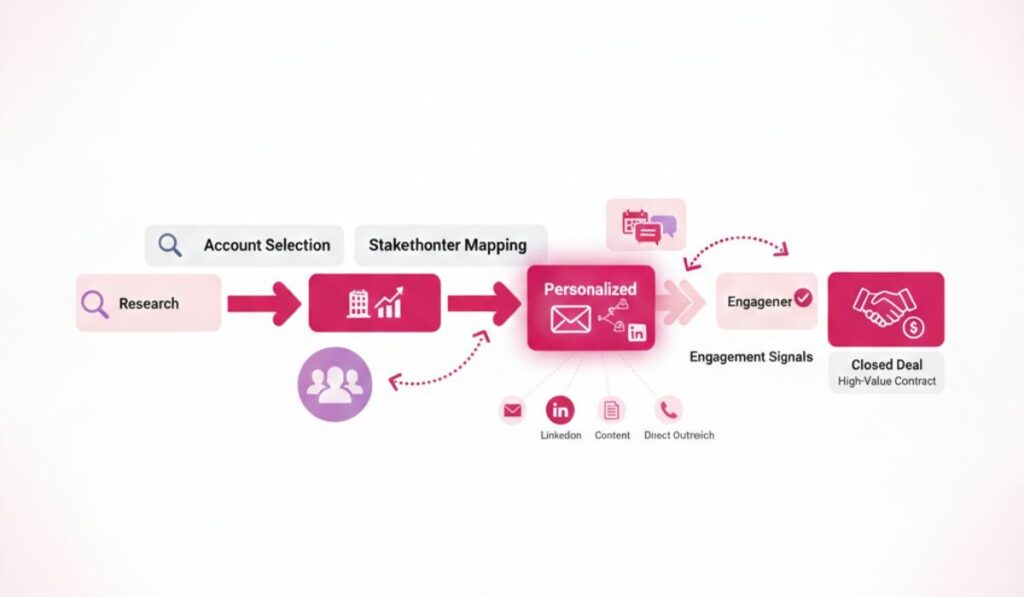
ABM makes sense when targeting 20-50 specific enterprise accounts worth $200K+ each. Instead of broad outreach, you coordinate personalized campaigns across email, LinkedIn, direct mail, and targeted content.
ABM Implementation:
- Identify 25 dream enterprise clients
- Research key stakeholders (VP Engineering, CTO, Director of Product)
- Create custom content addressing their specific challenges
- Coordinate touches across multiple channels over 90 days
- Measure engagement to identify warm accounts
ABM requires significant effort but conversion rates hit 30-40% on target accounts because every touchpoint feels personally relevant.
Building Your Prospect List (Where to Actually Find Qualified Leads)
Skip generic “CTO lists” from lead vendors. Build targeted lists using signals showing companies actively need development help right now.
Data Sources That Work:
LinkedIn Sales Navigator filters by company size, industry, job function, and seniority. Save searches for “Head of Product at Series A startups in FinTech” and get weekly alerts when new people match.
Apollo.io and ZoomInfo provide verified emails, company technographics, and intent signals. Look for companies using outdated tech stacks or posting developer job openings they can’t fill.
BuiltWith shows what technology companies currently use. Target businesses using legacy systems needing modernization or specific frameworks matching your expertise.
Buying Signals to Prioritize:
Fresh funding announcements signal budget availability and urgency. Companies that raised rounds 30-90 days ago are actively spending on product development.
Job posting patterns reveal capacity constraints. Multiple unfilled developer roles mean they need external help immediately.
Technology stack changes indicate active development projects. Companies migrating from web to mobile or adopting new frameworks need specialized expertise.
If list building and prospect research feels overwhelming while trying to deliver client work, B2B appointment setting services handle the entire prospecting workflow and deliver qualified meetings directly to your calendar.
What to Actually Say (Email Templates That Book Meetings)
Generic “we build apps, need help?” emails die in spam folders. Successful outreach leads with specific value relevant to the recipient’s current situation.
Funded Startup Template:
Subject: Quick win for [Company]’s MVP timeline
Hi [First Name], congrats on the [Series A/funding round]. Saw you’re hiring founding engineers – we’ve helped startups like [Similar Company] ship MVPs in 8 weeks when hiring got delayed.
If useful, I’ll send over our pre-launch checklist showing 3 shortcuts that cut 2-3 weeks off typical timelines. Worth a quick look?
– [Your name]
E-commerce/SMB Template:
Subject: Mobile conversion idea for [Company]
Hi [First Name], noticed [Company]’s app has a 4.1 rating with reviews mentioning checkout friction. We helped [Similar Brand] reduce cart abandonment 31% by fixing 3 specific mobile UX issues.
Happy to run a quick 15-minute app review and share what we’d prioritize first. Open to it?
– [Your name]
Enterprise Template:
Subject: 2-week pilot for [Company]’s [specific project]
Hi [First Name], we’ve delivered secure integrations (OAuth, SSO, API) for enterprise teams at [Similar Company] in 3-4 week sprints.
If you’re evaluating partners for [specific project they mentioned], we can run a 2-week pilot with money-back terms so you validate fit before scaling. Worth a brief chat?
– [Your name]
Follow-Up Sequence:
Most replies come after touches 2-4. Don’t quit after one email.
Day 3: “Circling back – did my note about the free audit get buried?”
Day 7: “One quick idea we tested for [Similar Client] cut development time 30%. Want the details?”
Day 14: “Last note – if the timing’s wrong now, when should I check back? “Studies show 80% of sales require 5+ touchpoints, yet most agencies give up after one attempt.
Tools & Tech Stack You’ll Need
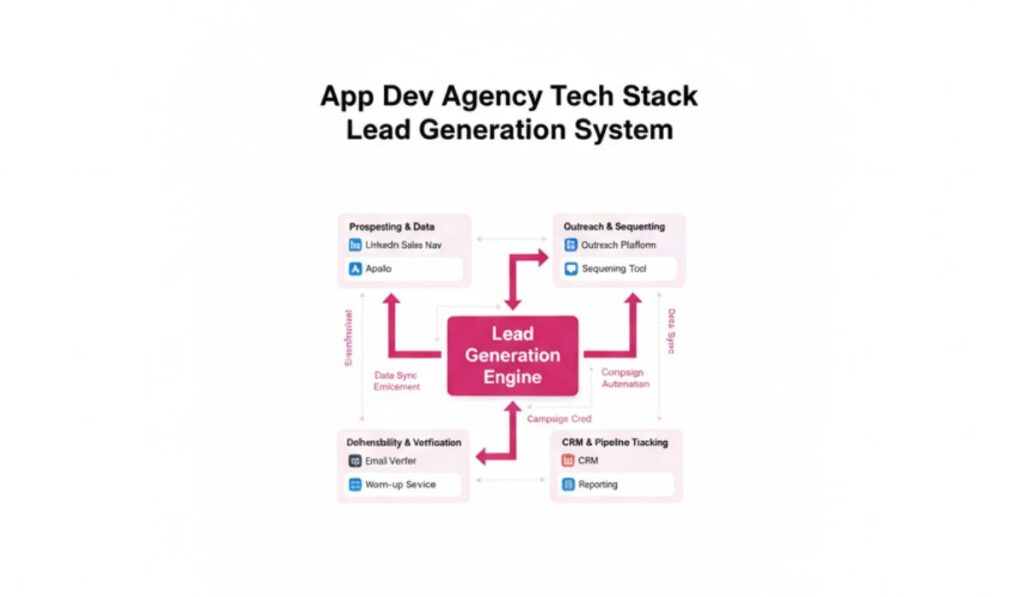
Running effective lead generation requires specific tools handling prospecting, outreach, deliverability, and tracking.
Prospecting & Data:
- LinkedIn Sales Navigator ($99/month) – best for finding decision-makers
- Apollo.io (from $49/month) – verified emails plus technographic data
- BuiltWith ($295/month) – technology stack intelligence
- Crunchbase Pro ($29/month) – funding tracking and startup discovery
Email Automation & Sequencing:
- Instantly.ai ($30/month) – unlimited sending with email warm-up
- Lemlist ($59/month) – personalization and multi-channel sequences
- Smartlead ($32/month) – deliverability-focused infrastructure
Deliverability & Verification:
- NeverBounce ($10 per 1,000 emails) – email verification
- Warmbox ($19/month) – automated domain warming
- Use dedicated sending domains, never your primary business email
CRM & Pipeline Tracking:
- HubSpot (free tier works fine starting out)
- Pipedrive ($14/month per user) – simple pipeline management
- Notion or Airtable (free) – if you’re bootstrapping
Total monthly investment runs $200-500 for full stack. For agencies wanting results without building internal systems, ProspectOut delivers 10-18 qualified appointments monthly while handling infrastructure, copywriting, and deliverability monitoring.
Should You Build This In-House or Outsource?
Building lead generation capabilities internally requires 40-60 hours setup time, $200-500 monthly tool costs, technical deliverability knowledge, and 60-90 days before seeing consistent results.
Build in-house if:
- You have dedicated BizDev/marketing team member with cold outreach experience
- Technical capability to manage domain authentication, email warm-up, and deliverability
- 90+ days to test, optimize, and scale before needing pipeline results
- Willingness to invest in learning curve and tool management
Consider outsourcing if:
- Founders/partners currently handling sales need to stay focused on delivery
- No one on team has cold outreach or email deliverability expertise
- Need qualified meetings in 30-45 days, not 90+ days
- Rather invest in proven systems than experiment with DIY approach
For agencies similar to yours in the AI and SaaS space, lead generation for AI development agencies and B2B SaaS lead generation follow nearly identical frameworks targeting funded startups and enterprise buyers.
The math is straightforward: if internal setup takes 90 days and costs $15K in tools plus team time, but outsourcing delivers qualified meetings in 30 days, the opportunity cost of building internally often exceeds the outsourcing investment.
Frequently Asked Questions
How much does lead generation cost for app development agencies?
DIY runs $200-500 monthly for tools plus 20-30 hours weekly. Outsourcing to specialized cold email agencies costs $500-2,000 monthly. Most agencies see positive ROI after 2-3 closed deals.
What’s a realistic response rate for cold outreach?
5-8% for targeted prospects with buying signals. Highly personalized campaigns to funded startups hit 12-18%. Below 3% signals messaging or targeting problems.
How long before we see results from lead generation?
First meetings within 3-4 weeks. Initial closes by week 8-10. Consistent pipeline with 10-15 monthly meetings by month three.
Should we target startups or enterprises?
Startups close faster (30-60 days) at 18-25% conversion with $30K-$80K deals. Enterprises take 4-6 months at 15-20% conversion but deliver $200K-$500K contracts. Most agencies target both with separate strategies.
What tools do we absolutely need?
LinkedIn Sales Navigator ($99/month), Instantly or Lemlist ($30-60/month), NeverBounce ($10 per 1,000), and HubSpot free or Pipedrive ($14/month). Total runs $150-200 monthly.
How do we find companies that just got funded?
Set up Crunchbase saved searches with daily alerts. Follow TechCrunch and VentureBeat. Join accelerator mailing lists announcing new cohorts.
Start Building Your Pipeline This Week
Most app development agencies stay stuck because they never move past research mode. They read guides, bookmark articles, and plan elaborate systems that never launch.
The agencies booking 15+ meetings monthly all started the same way: one target ICP, 50 qualified prospects, and 20 personalized emails sent in week one.
They tracked what worked, killed what didn’t, and doubled down on winning channels.
Results show up when you ship, not when you plan.
And if building this in-house feels overwhelming while delivering client work, ProspectOut books qualified meetings for you while your team stays focused on what you do best—shipping great apps.